
S
tories were everywhere around the Vietnam Traveling Memorial Wall while it was stationed in Blue Ridge.
Yet many, and I dare say most, stories were of the silent variety. These were the stories in the faces of the men and women, staring sometimes at the whole wall and at others focused on a single name.
The stories were in the eyes of people, some of whom would look at you and some who wouldn’t. They were in the embraces of the many veterans who paid their respects and especially those who escorted the wall into town.
There is a story in every one of the 58,267 engraved names, but like the men and women who could tell them, they are eternally silent.
There were a few people who talked, some a little, some more than others.
One man I spoke with the day the wall arrived told how his brother died a little over a year before. He had all the Agent Orange symptoms, but the VA denied that was the cause of his ailments. He didn’t have to say a thing – another horror story of the VA letting a veteran down.
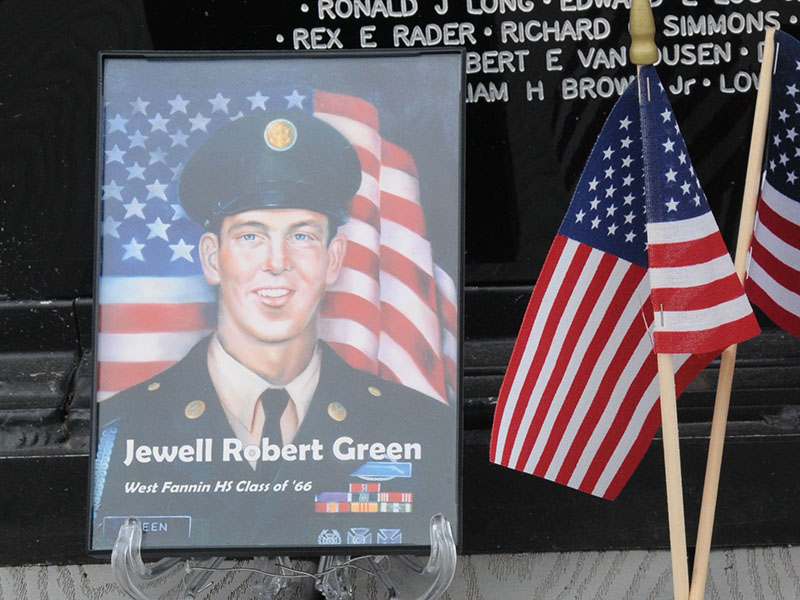
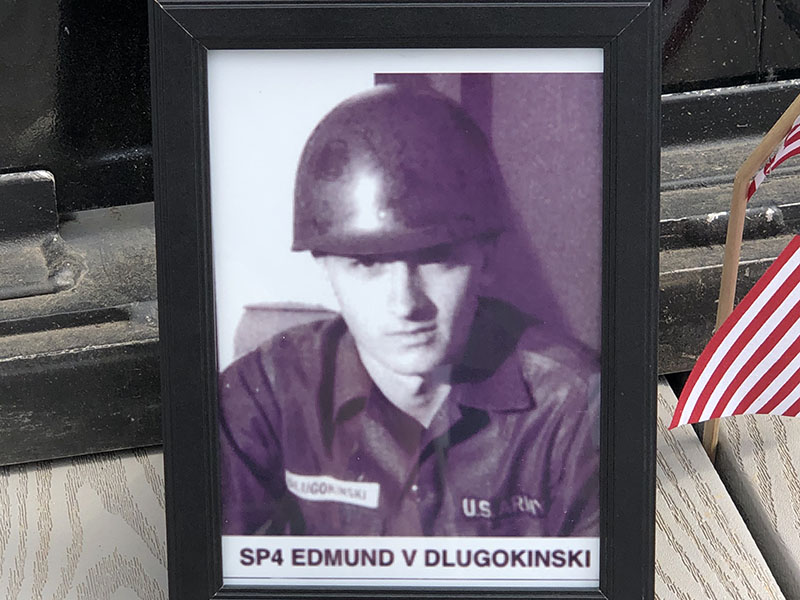
Two pictures stood at the foot of the Wall Sunday, those of SP4 Edmund V. Dlugokinski and the other of Jewell Robert Green.
My friend, Mark, told me the story of Edmund, his uncle. Edmund had just taken off his helmet to prop up Sergeant Jesse L. Harris, tending Jesse’s wounds. A .308 bullet ripped through both, Edmund first. Their names are on the wall, just as they died, one on top of the other.
Mark also told how Edmnund and his best friend tore a dollar bill in half, a half for each one, to put back together for a beer when they got home. One made it. One didn’t. A half of a dollar bill under Edmund’s picture honored that memory.
Mike Campbell had his own memories of the war in Southeast Asia. It was obvious his heart still bleeds for all the young men killed – the majority, 33 percent, of the names on the wall, belonging to 18 year olds.
But there were also the politics, the stinking politics, that have disappeared from history. Campbell remembers vividly how Americans won every battle, but the politicians in Washington, D.C., wouldn’t let them win the war.
Winning reflects honor. It comes from sacrifice. It should have been a lesson Vietnam taught in the halls of Congress. It wasn’t.
There was the social climate of the time. Servicemen and women returning from Vietnam were treated as criminals, not heroes.
Campbell pointed to a letter contained in the book prepared for the Wall’s Blue Ridge visit. That letter was from Julie Weaver of Burleson, Texas.
She described herself as a 20-something-year-old single mom during the Vietnan era. She talked of being manipulated by the media and becoming against the war. This drove a wedge between her and her brother when he returned from his service. That wedge went deep and lasted a long time.
Then she saw a picture of the anguished face of a Vietnam Veteran when the Vietnam Veterans Memorial was opened in Washington, D.C. And it hit her. She saw a tiny portion of what had been given.
She’s sorry. Now, she says “Thank you for going.”
Julie Weaver learned her lesson. Others should, too.
But it’s not just a lesson about Vietnam, it is a lesson to be learned about all who have served. In war, the lessons are hard. In peace, lessons are usually not as hard, but all service teaches what freedom costs. That’s a lesson for then, for now, and forever.
Glenn Harbison is publisher/editor of The News Observer. He can be reached at 706-632-2019 or by email at glenn@thenewsobserver.com.