
Eighty-eight years ago this July, one president’s decision would greatly influence the tiny town of Blue Ridge.
Almost three years into the Great Depression, on July 2, 1932, President Franklin D. Roosevelt pledged to ease the suffering of American citizens through the “New Deal,” according to Donald Rooney, director of exhibitions at the Atlanta History Center.
President Roosevelt went on to establish what would later become known as the “alphabet agencies.”
One of these agencies was the Works Progress Administration (WPA).
Others included the Civilian Conservation Corps (CCC); Federal Aviation Administration (FAA); Federal Deposit Insurance Corporation (FDIC); Federal Emergency Relief Administration (FERA); Public Works Administration (PWA); Rural Electrification Administration (REA); and, the Tennessee Valley Authority (TVA).
The TVA, to this day, still has a huge impact on the region, however, the WPA, even though the organization was relatively short-lived made a difference to the people of Blue Ridge by putting them back to work during the depression.
“The WPA provided jobs for over 8.5 million workers across the United States,” Rooney said.
Ram (renamed the Work Projects Administration in 1939) not only provided workers and their families a steady paycheck, but also offered a sense of stability and hope during the depths of the Great Depression.”
A woman by the name of Gay Bolling Shepperson was the administrator of the WPA and facilitated many projects, including the ones in Fannin County. At the time, it was uncommon for women to hold such positions, in fact, she was the only female administrator of the WPA in the United States.
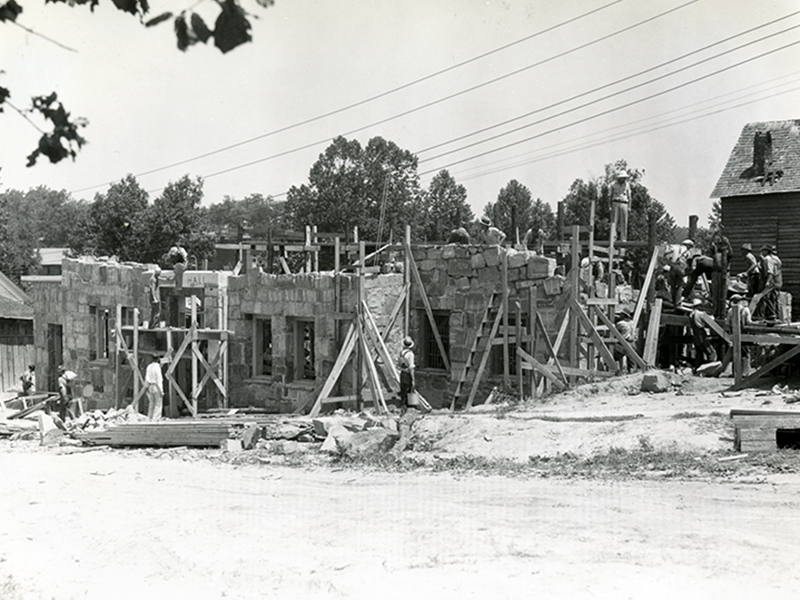
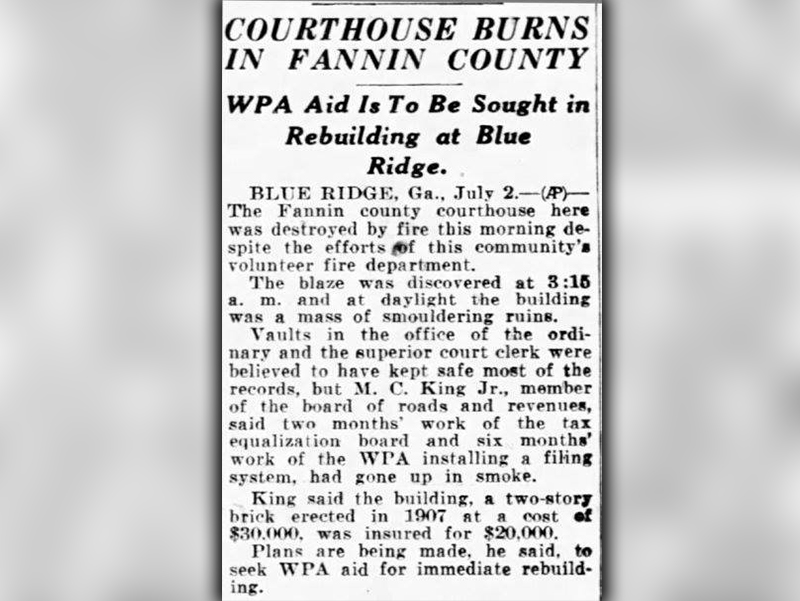
Local WPA workers constructed and built the original Blue Ridge City Hall and Jail in 1936-1937, as well as the Blue Ridge High School. It is said the WPA also helped rebuild the original Fannin County Courthouse after a fire on July 2, 1936. Rooney said typical projects of the WPA were constructing roads, parks, trails, and public buildings.
The TVA also was known to construct buildings and helped build various school buildings around the same time frame.
“Between 1933 to 1940, Georgia received $250 million in federal support,” said Rooney.
“State and local governments requested projects, hired private contractors, and usually provided 10 to 30% of the costs.”
The WPA was dissolved in 1942 when other work options became available. “During one of Roosevelt’s ‘fireside chats’ evening radio broadcasts, the President announced the end of the WPA; war industries provided ever increasing opportunities for employment,” said Rooney.
Interested in seeing one of the vintage buildings? The original city jail is now the Blue Ridge Police Department, and the original Fannin County Courthouse is now the Blue Ridge Mountains Arts Association’s Art Center.
Unfortunately, the Blue Ridge High School and its outbuildings, a teacherage and gym, are no longer around to share their secrets, but they were built on and around the site of the current location for Blue Ridge Elementary School, according to local historian Danny Mashburn.
President Roosevelt visited Georgia quite often. “Roosevelt was a frequent visitor to Warm Springs after he contracted polio,” said Rooney. “He utilized the pools at the resort town to heal his legs. Roosevelt visited Georgia over 41 times between 1924 and 1945, and consequently endeared himself to many of the state’s residents.”
Given that information, one would wonder if Roosevelt made a trip or two to Fannin County to take a dip in our own healing springs - Mineral Springs.