
Dangers: Students warned
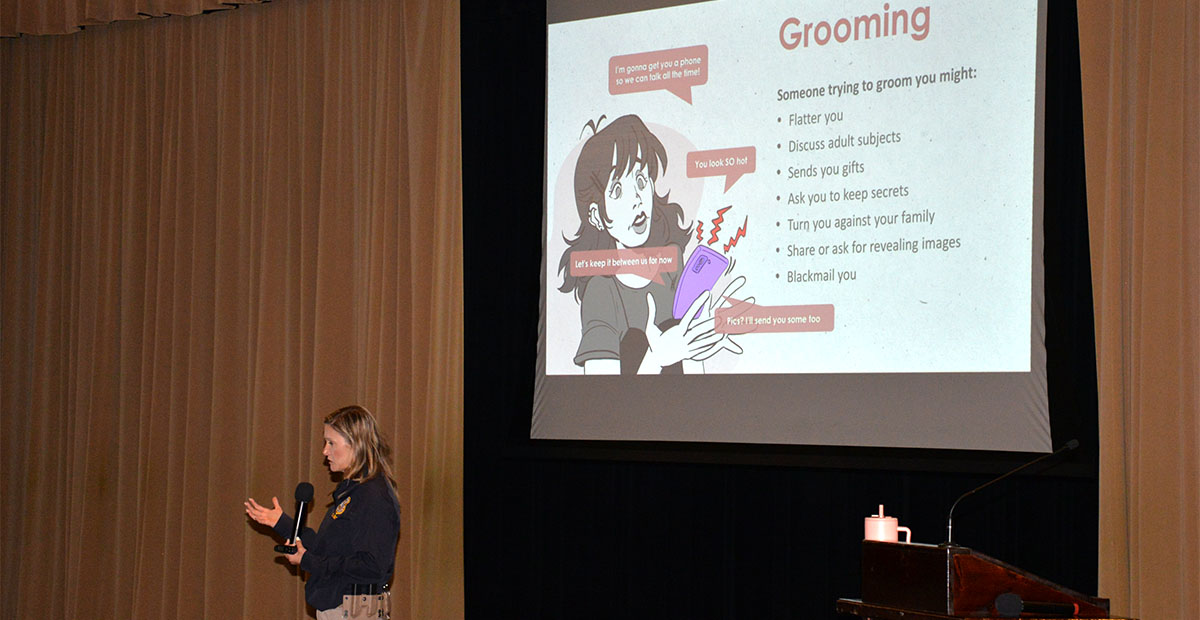

Renea Green sent a clear message to Fannin County High School students Friday morning when she told them everything they do will impact their future.
Green is assistant special agent in charge of the Georgia Bureau of Investigation Child Exploitation and Computer Crimes Unit.
She talked about cyber security, concentrating on the dangers of social media while warning students of the ways predators can hunt them down, how sexting can result in widespread embarrassment or even placement on the Sex Offender Registry, and the newest scam targeting their money through blackmail.
“No matter the app that is out there, it’s going to be used for millions of purposes,” Green said as she began explaining some of the tricks predators use to locate and lure their victims.
“Don’t think that you have to post everything that you’re doing,” Green said. Doing so can ruin a reputation, get a person in trouble, or even ruin future opportunities.
Posting pictures, comments, or anything to social media does not go away, and then specifically referred to Snapchat.
While most think Snapchat posts disappear, law enforcement has ways to retrieve them. Also, for instance, pictures that are sent and saved on another device do not disappear.
When describing predators’ tricks, Green included the warning, “These predators...they’ve got nothing but time.”
They develop friendships through gaming platforms, convincing teenagers and children they are the same age, have the same interests, and sympathize with their problems, all in order to gain their confidence. For teenagers, they might use compliments and gifts as they work to determine where their victim lives.
Green warned students to never give out too much information and be careful who they “friend.”
“Why do we need to share our location?,” she asked.
Once predators find a “friend’s” school, for instance, they begin using that connection to “friend” and target others.
Cyber bullying has made bullying easy to hide from the victim. Yet cyber bullying, in the worse cases, has led to suicides, Green said. “How would you feel on either side?,” of such a situation, Green asked the students.
Sexting, sharing explicit photos before turning 18 years old, brings laws governing child sexual abuse materials into play.
Green described what is a common scenario. A young boy and girl believe they are truly “in love,” so they send explicit photos to each other. They promise never to show them to anyone else, but the boy has to brag and shows just one person. The couple breaks up, an explicit photo is shown, parents complain to the school, and law enforcement gets involved.
The crimes; if a person takes an explicit photo, even of them self, they have manufactured it, since it’s on their phone, they’re in possession of it, and when they send it to someone, they have distributed it.
The person who receives it becomes in possession of it and when they share it, even show it, to someone, they have distributed it.
At the core of this scenario, “Sometimes people you trust break that trust,” Green said.
Manufacture, possession, and distribution of child abuse material are all felonies. Conviction for any one can result in the guilty party being placed on the Sex Offender Registry for life.
Also, Electronic Service Providers who spot explicit pictures of children are required to report them to law enforcement. Investigations result.
Green warned of the latest scam targeting 12 to 16 year olds, and usually boys.
Through social media, they are contacted and befriended by a “very cute” girl who wants to swap explicit photos. She sends hers’ first and asks the boy to respond with one that shows his face.
Right away he gets a demand for $500 to keep the picture from being sent to everyone in his school, his family, and posted on the internet.
These scam artists, who are located in Nigeria, are “very aggressive,” Green said. “Once you hit send, you lose all control.”
Throughout her presentation, Green urged students to “think before you hit send.” She told them to walk away and consider what they were about to do.
Green also told the students when they mess up, when they do make a bad decision, “Don’t feel like it’s your fault.”
She provided a list of resources and urged them to seek help, whatever help they might need.
Fannin students in grades five through 12 heard of dangers
Fannin County students in grades five through seniors in high school heard about the dangers of social media and the internet in a series of presentations Friday, April 19.
Renea Green, assistant special agent in charge of the Georgia Bureau of Investigation’s Child Exploitation and Computer Crimes Unit, and special agents Katelyn Flowers and Trisha Cannon, presented programs at the high school, middle school, and all three elementary schools.
Green, who talked with high school students, said all the programs addressed the same warnings, but the lower grade presentations were toned down for the age groups.
Program topics included the dangers of predators and their tactics, ruined reputations, criminal records, scam artists, and cyber bullying.
Fannin County Sheriff Dane Kirby arranged for the programs to be presented after learning of them from Gilmer County Sheriff Stacy Nicholson.
Fannin County School Superintendent Shannon Dillard expressed the system’s thanks to Kirby. “Our students heard about some very real dangers that they may not have known existed thanks to the sheriff. The GBI agents did a wonderful job. It was obvious our kids paid attention,” Dillard said.