
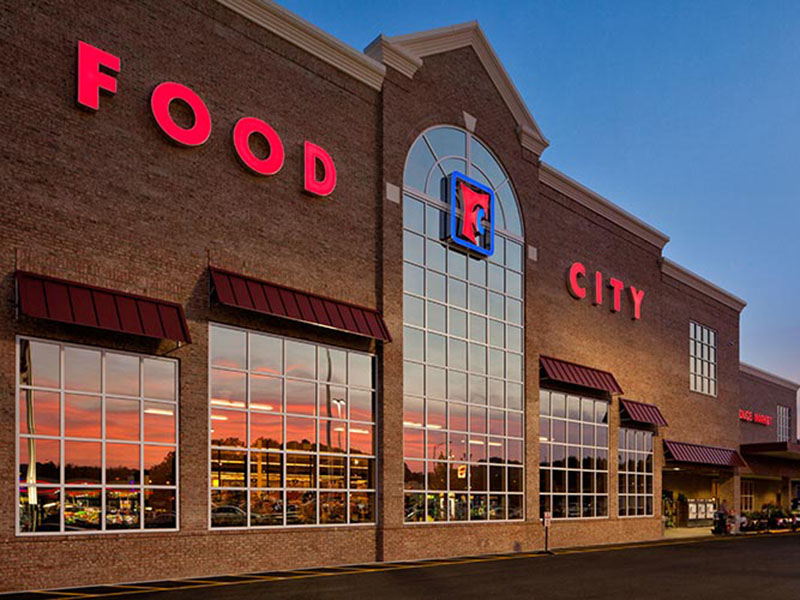
Members of Polk County’s Industrial and Economic Development Board (IED Board) have agreed to continue negotiations with Food City over a Payment in Lieu of Taxes (PILOT) program, a tax abatement, for a new grocery store at the intersection of highways 64 and 411.
Differences will have to be worked out in those negotiations. “What they believe to be the agreement and what the board believes to be the agreement may not align,” Ginger Buchanan told board members when they met Thursday, February 8, in Benton.
A lack of written documents between the IED Board and Food City outlining their agreement lies at the center of confusion.
IED Board Chairman Ryan Cooke and Buchanan, the board’s attorney, discussed a phone call they had with Food City officials. Food City’s attorney, who had not been involved in negotiations, joined that call, Buchanan said.
Members of the Polk County board want Food City to hit certain benchmarks (metrics) in connection with projections the grocery giant has made for the new store. Those include job creation, investment, and sales. Food City officials say they did not agree to this in the original negotiations.
Food City anticipates 162 jobs, an investment of $15,585,000, and annual grocery sales of $19,500,000.
Polk officials want Food City to first define the jobs, expecting all 162 to be full time at the Polk County location.
IED Board members feel failure to hit the benchmarks should reduce any tax abatement. Food City has agreed to benchmarks, but wants success in reaching them to be averaged over several years. The majority of IED Board members at the meeting felt they should be met yearly.
There is also a difference of opinion among board members as to a penalty if benchmarks are not achieved. Ken Bishop is pushing for a complete loss of that year’s tax abatement, believing Food City should meet every benchmark every year or lose its entire tax break. Mark Allen wants a prorated formula. For instance, if Food City hit 80% of its projection, the 100% tax abatement would only be reduced by 20%.
Bishop also said inflation should be factored into the annual sales metrics since groceries are not going to cost the same in future years as they do today.
Buchanan said that Food City understood the PILOT program offer from the IED Board to be that they would pay neither county or school property tax for 15 years. Both Cooke and Bishop specifically remembered the offer was 15 years with a cap of $750,000 in forgiven property taxes. Their memory was backed up by board minutes read by Cooke.
Cooke also wants Food City to pay the school portion of its property tax bill.
Earlier in the meeting, Jonathon Connell of the Southeast Tennessee Development District, presented figures showing Food City would generate approximately $10 million in sales tax for Polk County while the county was only being asked to give up approximately $630,000 in property taxes.
His projections drew numerous concerns from some board members and the audience. Cooke pointed out that the figures were based on the entire development that includes other retail sales and the tax abatement only affects the new Food City grocery store.
IED Board members agreed for Buchanan to draft a proposal to be sent to Food City. A special called meeting of the IED Board will be held prior to that proposal being sent.