
“Doc, go do your thing.” These were the words that then 25-year-old Elissa Lonsdale-Nester probably thought she would never hear, but heard them loud and clear during her time in Iraq in 2003.
Nester was freshly out of high school in 1997 when she sat her father down and told him she’d be joining the Army. She told him “If I don’t get out now, it’s never going to happen,” referring to her small town and the path she was on.
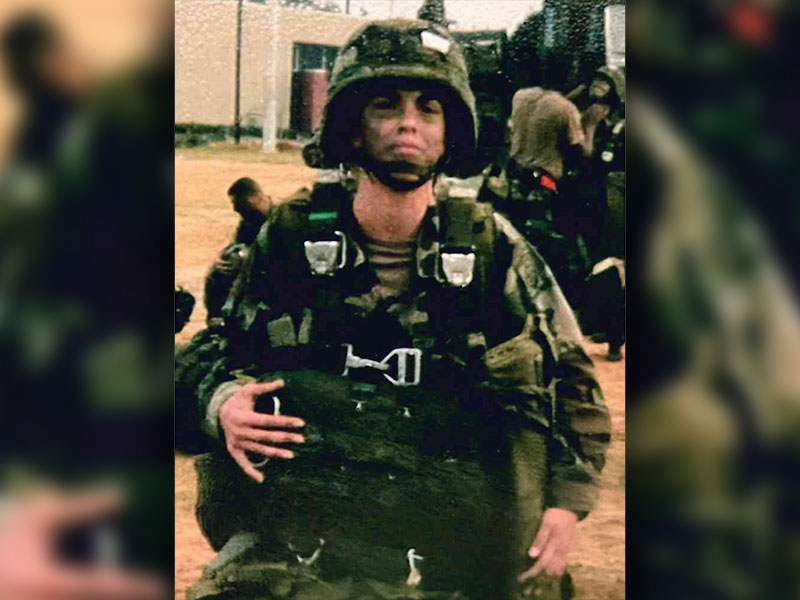
Nester attended basic training at Fort Leonard Wood before making her way into Advanced Individual Training (AIT). She would learn the necessary skills for a career as a combat medic. Her next stop was Airborne school at Fort Benning where she would learn how to jump out of airplanes. “It was fun... Everyone thought I was crazy, but it was fun,” she said.
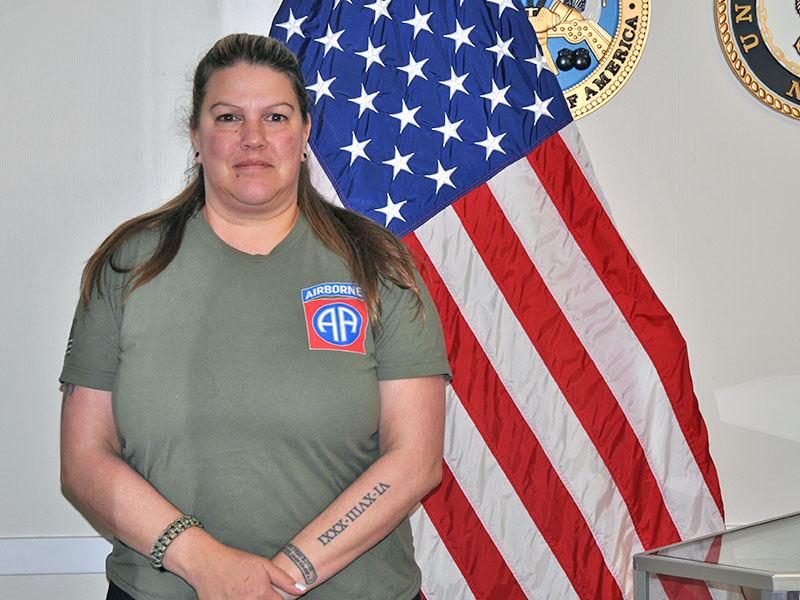
From there, Nester would find herself at Fort Bragg in the 82nd Airborne Division from March 1998 until September 2001. She would earn her maroon beret there, a symbol of her status as an airborne soldier.
“9/11 was a huge wakeup call,” Nester said. Her initial plan had been to enlist and serve her four years, and then go to college and become a civilian. “But then 9/11 happened, and I was like, no, I need to hang out and see what happens.”
In late 2001, Nester was assigned to Italy where she was able to see most of Europe and even had her own apartment. Her experience included jumping out of airplanes and helicopters with Italian and German paratroopers.
By 2003, Nester was deployed to Kirkuq, Iraq, with the 173rd Airborne Brigade as a part of the initial invasion.
“We had, like, no resources,” she laughed and continued, saying that when she got there, soldiers were on a water bottle ration of one and a half bottles a day. The soldiers slept in tents with no air conditioning and no personal space. “We had to do our laundry in buckets and there’s no showers,” she laughed.
She would turn 25 years old in Iraq, having treated over 5,000 casualties there.
“It was a war zone.” Nester said. Nightly mortar rounds were fired by the enemy. “You grit your teeth and just wait it out,” she said.
Within the year of her deployment, Nester was involved in an IED attack.
She was assigned to a convoy as a medic to pick up X-ray film from Tikrit, Iraq. The convoy consisted of about 18 trucks. Half an hour down the road, Nester decided to sit in the last truck in the convoy because she had friends in that truck, as she didn’t seem to know anyone else in the first 17 trucks.
The convoy reached Tikrit, loaded their trucks with the needed supplies, and began to return to Kirkuq. During the convoy briefing, Nester was told that the last truck in the convoy would be the most dangerous place to sit because the enemy would target the very last truck with IED’s because they knew that retaliation would be much slower because the front trucks would have to turn around. Because of this warning, Nester moved to the first truck in the convoy, the commander’s truck.
Twenty minutes later, an explosion rang out. The commander was on the radio and turned to her, saying “Doc, go do your thing. The last truck got hit.”
Amidst all the shelling and gunfire, Nester made her way back to the truck where her friends had been. She recalls seeing the truck unmanned and rolling away, surrounded by debris.
“I thought, in my mind, that this is the day I am going to die...But I was proud that I was going to die doing my job,” she said.
Thankfully, no one died. “They were really banged up. You know, fractures and shrapnel wounds that I had to treat,” Nester said.
The injured were airlifted to a hospital and the convoy got back on the road to Kirkuq.
The very next day, Nester received a Combat Medic Badge in front of her entire company, a badge only given to medics who faced combat.
The mangled truck was towed back to the base in Kirkuq, where Nester saw for herself how close she had come to death. “I really don’t think I would have survived that, if I was in the truck,” she said, adding that the back seats of the vehicle had been completely blown out.
By the end of her 2003 deployment, Nester was desperate for a “mental health break.” In what she called a “not-so-great” decision by the Army, Nester was sent to Fort Benning’s Martin Army Community Hospital as an Emergency Room medic.
“I saw more stuff in the E.R. than I thought I would.” Nester said that she had originally asked the Army to send her somewhere more relaxed – the ER would not be her haven.
“In the ER, it was a lot of kids and family members of soldiers that were deployed,” Nester said. “Treating kids and babies is just not something I really enjoy doing. Especially when they’re really hurt... It was not fun.”
Nester would spend a year at the hospital before she received orders from the Army to go to Drill Sergeant School in 2005. She would be “on the trail,” or a drill sergeant in Fort Sam Houston in Texas from 2006 to 2008.
“It was one of the most exhausting two years of my life because I worked such long hours, but it was also the most rewarding.” Nester said. She would work from 3:30 a.m. to about 9 p.m. at night. She recalls getting home some nights and having to choose between eating, showering, or just going to sleep before she had to wake up again a few hours later to go back to work. “At the same time, [it] was so rewarding because you get to mold and teach these soldiers.”
While she was a drill sergeant, Nester developed a program called AIP, or Airborne Introduction Program, as there was no proper preparation program for airborne school. After having spent eight years in the airborne division, Nester felt called to help lead young soldiers and teach them how to do what she loved.
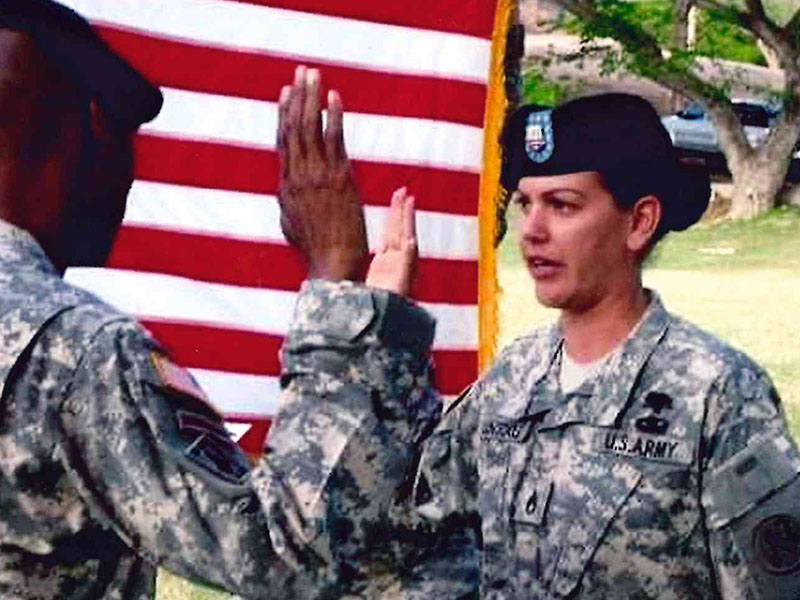
When her time as a drill sergeant came to an end, Nester was given a choice on where she’d like to be stationed next. She chose to go to Hawaii, saying she’d never been and she wanted to go. So, in early 2009, Nester shipped out to Hawaii, arriving as Platoon Sergeant for Command.
Nester began working for a colonel at the US PACOM, or the United States Pacific Command. While she worked for him, she’d begin to write a book. The book, albeit a shorter one, followed her 2003 deployment to Iraq and the experiences she had there.
“I had gone to this PTSD seminar in Hawaii, and he’s like, just write everything down, just write all your feelings, write everything you did in Iraq,” Nester said of the seminar leader.
By 2009, Nester shipped out once more to Iraq. “It was better,” Nester said of her ’09 deployment, adding “I had my own CHU,” a Contained Housing Unit akin to a Con-Ex shipping container.
She was the senior medic for the Aviation Brigade and worked higher up in the chain of command. There, she wrote Frago orders, or daily operation orders. The job required that she read operation orders and divide the tasks and missions of the operation throughout the companies.
“I got to work night shift for awhile, so that was nice,” Nester said. “I didn’t see a lot of action in ’09, but I was okay with that.”
Following her deployment, Nester found herself back in Hawaii for three more years. There, she would get married and begin starting a family. She became pregnant in Hawaii, and in 2012, Nester would be transferred to Fort Carson in Colorado.
After struggling with her mental health at Fort Carson for roughly three years, Nester recalls being “present, but not really present.” She reached out to a lieutenant in her unit for help. She would begin her healing process, thanks to the help of therapy and her own strong will to move forward.
From there, Nester was placed in a unit called Warriors in Transition Unit, or WTU. The unit is essentially where the Army would place soldiers when they’d been injured or disabled in combat, before they join the Wounded Warriors program.
“My wounds were not visible,” Nester said. The last six months she spent in the unit, she recalls the Army slowly letting her know that she was going to be retired early. She remembers feeling awful about this situation, expressing her frustration at being just two years shy of hitting her twenty year mark.
By March of 2015, Nester was medically retired from the Army.
“In the long run, it ended up being better financially and the benefits are better,” she said.
“I’d do it again in a heartbeat,” she said. “You get out of it what you put into it.”
Nester moved to the North Georgia mountains just five months ago with her husband, son, and step-daughter. She works now as a Mobile CPR Instructor, teaching how to properly and safely perform life-saving measures.
When asked what she would say to a young person who was interested in enlisting, she said “Do it. It’s a great experience.”