
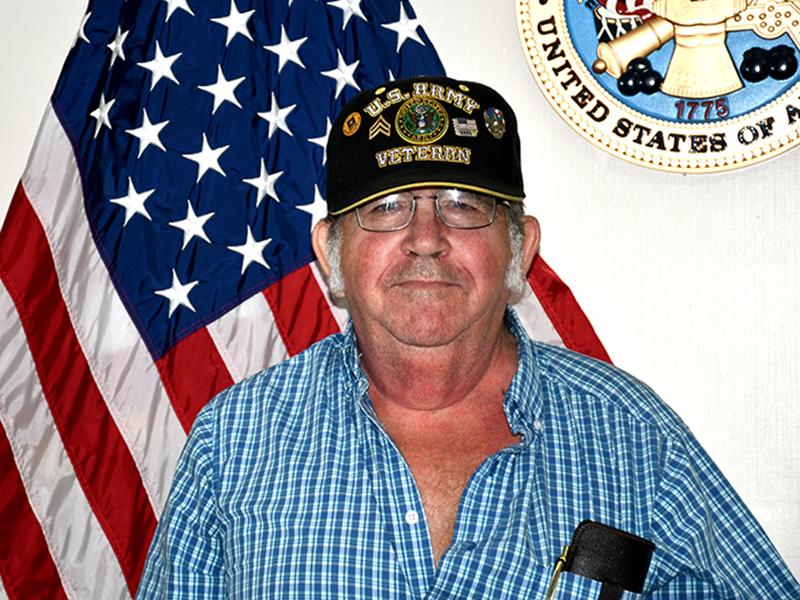

Fannin County native Charles Spivey spent two and half years serving his country in the United States Army during the Vietnam War, and while he’d do it again in a heartbeat, he endured hardships on and off American soil during his service.
While Spivey was born in Ellijay in 1946, his family moved to Fannin County the next year after his father started working at Tennessee Copper Company.
In 1966, at the age of 18, Spivey received a letter from President Lyndon B. Johnson drafting him into military service.
“I was drafted,” he said. “I didn’t volunteer. I started my basic down here at Fort Benning, Georgia. I left there and went to Fort Seal, Oklahoma, for artillery school.”
Spivey was then deployed to Bremerhaven, Germany, with over 5,000 fellow soldiers traveling on a ship with him.
“When we got deployed to Germany, we thought we were going to Vietnam, but we wound up in Germany,” he said. “When I was in there, if you went anywhere, they gave you a cheese sandwich and an orange in a brown paper poke. Everywhere we went, that’s what they fed you.”
After arriving in Bremerhaven, he was sent to Frankfurt on a train and then started traveling to the mountains via bus.
“I went to Germany in July of 1966, 19 years old,” he said. “We went up in the mountains. I had on my khakis, that’s a summer dress uniform, because when we left Oklahoma it was 120 degrees. When we got up in that little Bavarian town in Germany, it was 32 degrees and snowing.”
He and his fellow soldiers made it to the 1st Battalion 94th Artillery in Furth, Germany, which was approximately seven clicks, or around 10 miles, from Nuremberg. They found five soldiers there that were then deployed to Vietnam, and they took their place in Furth. The Regular Army (RAs) were sent to Vietnam, and those left, including Spivey, were able to pick their own job in Germany.
“I started out as a gunner,” he said. “I said, ‘I don’t want to be no gunner. I want to work on them.’ So I asked them if I could work on them, and they said, ‘Yeah.’ So I became a mechanic, and that’s what I done while I was over there.”
He was a Spec 4 at the time.
“I made rank pretty quick over there, because there weren’t that many people so you could make rank,” he said.
In October of 1967, he made E5, and he was over all the mechanics. He then traveled to Grafenwoehr, Germany.
“That’s where Hitler trained all of his troops,” he said.
In total, Spivey served about two and a half years in the Army, all of which he spent in Germany. He left in 1968.
While Spivey was awarded the National Defense Service Medal, he never actually received it. When he returned home, he returned to a country of Americans in protest.
“We were the scum of the earth, which we were over there, and we were over here when we came back,” he said through tears. “Even though I didn’t serve in Vietnam, I was still the scum of the earth. That’s the pain part of it. You go defend your country, I didn’t ask to go over there, but I’d do it again tomorrow.
“The American people, that’s what pisses you off. … That’s the hard part. When you put your life on the line, 19 years old, 18, 40, 70, I don’t care what age you are, when you put your life on the line for your country, and you’re the scum of the earth when you come back here, that pisses you off. People come up to you today and thank you for your service, but where were you in 1968 when I come home?”
Fellow Army veteran, Ray Arthur, who served more recently in Iraq, said, “My generation has had it a little bit easier coming home from the war, because of Charles’ generation. Those were dark times in the U.S., dark, dark times. Because of the sacrifices they made, and the stuff they had to endure when they came back home, I didn’t endure that when I came off. When I came off the plane, everybody was waving flags. Hopefully, America learned a lesson during the 60s and 70s.”
Spivey is now 74 and retired from his work at Rural Carpet in Dalton, Georgia. He had previously worked for The Tennessee Chemical Company. His wife of 49 years, Mary Sue, passed away last year.
Spivey is one of many veterans who did not know they had military benefits until long after their service.
“I didn’t know there was a VA (Veterans Affairs),” he said. “When I got out of Fort Dixon, New Jersey, they sent me to the house. I didn’t know we had benefits. Nobody told me nothin'.”
This lack of knowledge has caused financial hardships during times of medical need. It wasn’t until well after 2009 that he first heard about getting his benefits. He now has Tinnitus benefits due to the ringing in his ear that he’s had since his service.
Spivey said that many veterans are still unaware of the benefits they are able to receive to this day.
Those considering military service should “follow your heart,” Spivey said. He said the decision was something someone had to make on their own, but he’d do it all over again.