
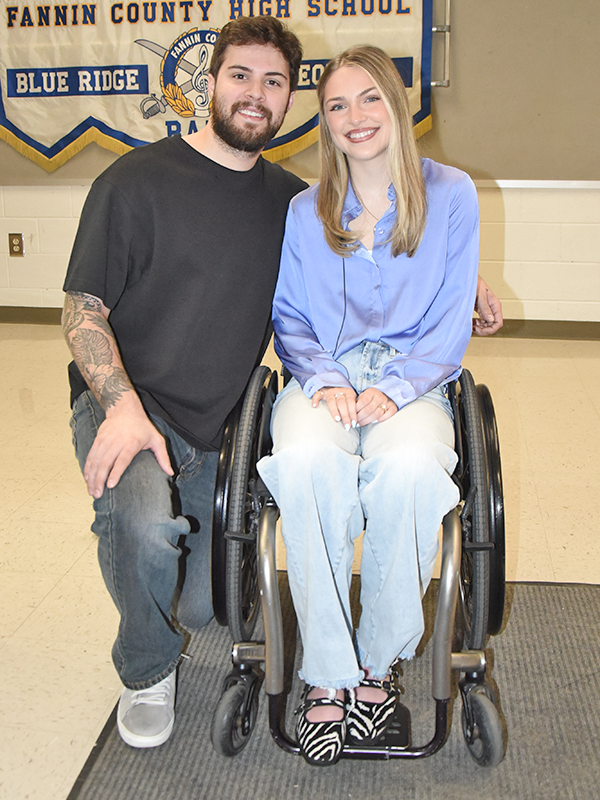
Her mother’s terror-filled 911 call introduced Emma Benoit’s life to the students at Fannin County High School.
They heard the frantic voice of Chelsey Benoit who had discovered her 16-year-old daughter laying on the floor of the family’s Louisiana home bleeding, unresponsive and barely breathing.
The gunshot from a suicide attempt would start Emma on a mission to help others find hope and stay alive. That mission has been one of recovery and rehabilitation, spiritual as well as physical and emotional.
Eighth through twelfth graders filled the Performing Arts Center at FCHS last Wednesday to watch the documentary film about Emma’s story, My Ascension, and hear from the person who no one believed would ever consider taking her own life. “I put a mask on...happy, outgoing, always smiling on the outside,” Emma said.
“I didn’t have a clue she was struggling,” her mother said.
Emma’s hidden battle with anxiety and depression became the catalyst for her life mission. She works to raise awareness, provide hope, and remove the stigma that tells people, young and old alike, that is not okay to talk – to speak up when you face a problem.
Emma begins her story recalling how, immediately after her she tried to kill herself, she knew she really did not want to die.
Then, she woke up in the hospital, only to learn she was paralyzed. “She looked broken,” her brother, Britton, said.
Her journey began with the physical battle to walk again and fully use the upper part of her body. Progress was slow, sometimes seeming nonexistent.
Along the way, angry, she cried out to God, “Why me?” She questioned whether He really did have a plan for her. Emma told how she heard His voice clearly telling her to “be patient,” and from that moment a peace came over her. Emma knew there was a purpose for her life.
Throughout My Ascension, students witness how Emma has worked to achieve that purpose. They also hear from family and friends.
There are the stories of two others in My Ascension, remarkable young people who tragically did not survive their suicide attempts. Students hear first-hand from their families, friends, school officials and suicide prevention experts the devastating effects left behind when someone takes his or her own life.
Twenty young people, those under the age of 25, die every day in the United States by suicide, according to the National Institute on Mental Health. That number was approximately 7,600 in 2018, one year alone. The rate is up 33 percent since 1999.
In her message of hope, Emma is convinced young people do not want to die, they just want their pain to go away. “If we don’t tell someone about our pain it will likely never go away,” she said.
But young people won’t reach out because of the taboo that you are weak if you seek help, if you talk to someone. That, Emma said, must be overcome. Family, friends, teachers – everyone – can help and should because suicide is a community issue.
She told students, “There is no shame in therapy. Choose to take care of yourself. Find people who make you feel safe.”
She urges everyone to listen actively, to connect with what is happening in the lives of others. This means talking about feelings. “Emotions, feelings aren’t always comfortable, but they are part of life. Don’t wait expecting them to be comfortable,” Emma said.
She encouraged adults to look for warning signs that a young person is having trouble coping with life. “Recognize changes in baseline behavior. The way you think affects the way you feel. The way you feel affects the way you act,” Emma said.
She told how she was always hard on herself to do better. Then an obvious loss of interest came along.
And another tip for everyone, “Tell your loved one how much they mean to you today. Don’t wait to tell others at the funeral.”
Emma reminded students, “The four walls of this school aren’t your permanent home. Things that we all assume are so very important aren’t so important.”
Now, looking back, when does Emma know she first needed help? In the sixth grade.
“You never think it’s (suicide) going to happen until it does,” Emma said.
Over years of struggle, Emma has regained about 80 percent of her mobility. She still uses a wheelchair sometimes, and the fingers on her left hand are still hard to maneuver. “There is a purpose in every experience. We are all here for a reason,” Emma said.
If you or someone you know needs help, talk to someone. Call the Suicide Prevention Lifeline at 1-800-273-8255 or text the Crisis Text Line – HELLO to 741741.
More about Emma’s story can be found at www.MyAscension.us or at www.facebook.com/myascension.