
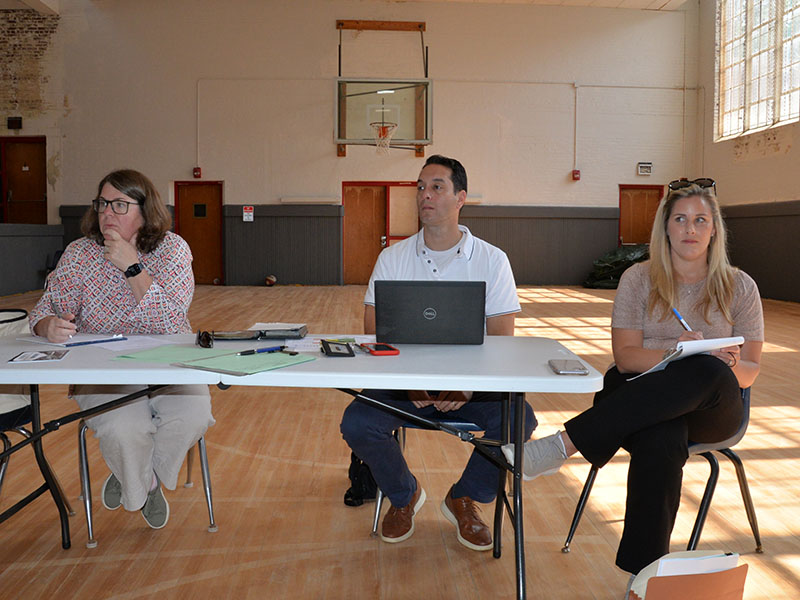
A team from the Carl Vinson Institute of Government at the University of Georgia began their part last week to “Reimagine the OWC” (Ocoee Whitewater Center).
Their effort is part of a “collaborative visioning process” underway by the U.S. Forest Service to guide the future of the OWC and associated administrative site.
Originally built for the 1996 Olympics, the building was destroyed by fire April 26, 2022. The day use area remains open.
The Forest Service plan involves the building, whitewater course, and entire site. The planning process will include architects, designers, engineers and cost modelers.
The group from the Carl Vinson Institute is working to collect the public’s priorities for the site. Members held their first meetings in Ducktown at Kimsey Ridge last week.
Leigh Elkins is the leader of the group. She is joined by Danny Bivins who headed up the Copper Basin project, and Kaitlin Messich.
Elkins told one of the first groups of community members they are, “hearing the real loss people feel,” from the result of the fire.
Their goal is to provide “what folks want to see” to revive a “beloved community asset.”
The small group gathered for a morning session Wednesday, June 7, urged a new building hold true to the theme of the previous facility.
“Keep those elements that make us a unique people,” Sarah Rigdon urged.
She told of how the facility was a great place to take school groups to educate children about the environment and history of the area.
The group agreed the site should not be commercialized, but used as a hub for information.
Copper Basin Fire Department and Rescue Chief Marty Senterfitt, like Rigdon, spoke of the amount of pride the community felt in the center. Being relatively new to the area, he said the OWC was the “one icon that made Polk County Polk County” to many people.
He was amazed by “the amount of pain that the community felt” when the building was destroyed.
Senterfitt urged that its reconstruction include a place for rescue equipment to speed up the process when the need arises.
Currently, for rescues on the river or hunts for lost hikers, equipment must be transported from the fire department headquarters at the Copper Basin Community Center. This can slow the response time for taking care of someone in need, Senterfitt explained.
He also pointed to the OWC venue as a “centralized rally point” for both emergencies and training, and urged those factors be considered in the planning.
Bivins said the sessions being conducted with the public were only the beginning and the Carl Vinson team plans to return in July and August.
Those wishing to voice their opinion on the future of the OWC can go to www.reimaginetheowc.org and take the survey.