
Hometown Heroes

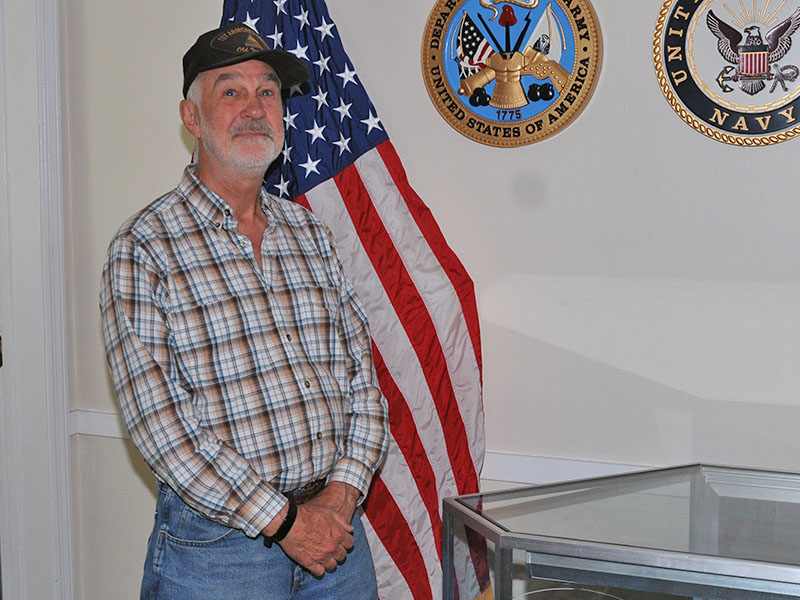
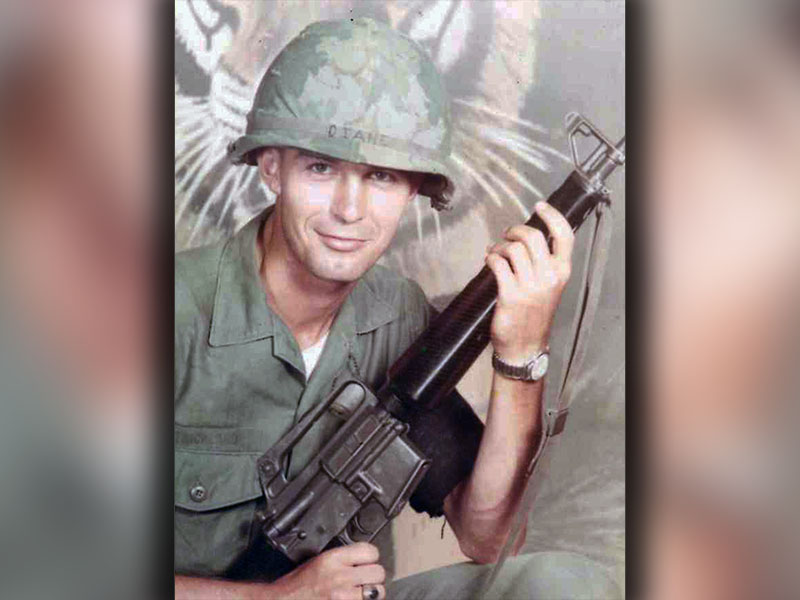
“I didn’t choose the Army, the Army chose me...It took a whole lot of boy out of this body and put a man in.” That’s the way Steve Strickland describes his two years of service while the Vietnam War was still ranging.
But he didn’t go to Vietnam, and what happened to prevent that duty leaves him with a question he doesn’t have an answer for today.
Strickland, now a young 75 years old and living in the mountains of Fannin County, was born in East Etowah, Tennessee, in 1947, two years after World War II ended.
When he was six years old his family moved to Atlanta and it was there he began his education.
Once in high school, he spent three years in the Junior Reserve Officer Training Corps (JrROTC), time he enjoyed, but with no mention of continuing in the military.
He graduated high school in 1965 and went to Barber School where he earned his Master Barber credentials in March 1966. Strickland explains this vocational training came out of necessity as he worked to help his dad raise enough money so Steve could go to college.
Strickland would spend time at both West Georgia College and Kennesaw Junior College.
Then his draft notice arrived in 1969 and he entered the Army April 3 of that year.
Strickland remembers reporting to the reception station on Ponce de Leon Avenue in Atlanta. Going through the line, a lady asked him, “Do you want to go in the Army or Marines?” He had not given a choice a thought, thinking his future in the service was already determined. He told her the Army called him so that’s where he was going.
He admits that decision was one of a young kid with no idea of how to look to the future. “I was a barber,” he said. “I could have gone into the Navy and spent my time on some ship in blue waters cutting hair. I wasn’t smart enough.”
He was sent to Fort Benning, Georgia, for basic training.
His next stop was Infantry Advanced Individual Training (AIT) at Fort Polk, Louisiana. He was there from July until August 1969. He remembers his time at Fort Polk as “the hottest I’ve ever been in my life.” Strickland remembers how drying off after a shower would cause a person to start sweating all over again.
At Fort Polk, Strickland volunteered for Non-Commissioned Officer (NCO)School and he was sent back to Fort Benning. His duty there started there in September 1969 before ending abruptly in November of that year.
During training, Strickland was jumping off a deuce-and-a-half, a two-and-a-half ton truck. The tailgate was held up by its chains, straight out from the bed of the truck carrying soldiers. As he jumped, Strickland’s toe got caught in the handle/step on what was the end of the tailgate. He was soon hanging upside down.
He tells everyone his ankle was broken, but admits what happened was “everything in there,” ligaments, tendons, muscles, everything was torn.
Strickland was medivaced to Martin Army Hospital just outside Fort Benning. He was in three different casts for 10 weeks. “It just wouldn’t heal,” he said.
Once he did come out of the casts, he was sent to Fort Hood, Texas, where he was assigned to the 1st Armored Division as an armorer. He was responsible for maintaining rifles, pistols and other small arms.
The certificate he earned through JrROTC in high school gave him an early jump start as an E-3, private first class. Because of his leadership training he was promoted to corporal, giving him authority over soldiers of a similar, E-4 pay grade.
Along the way, during his military service, he had married his first wife, Diane, in August 1969. Their first child was born in June 1970. The family was able to live together off base at Fort Hood as Strickland finished his service.
Then came Strickland’s ETS (expiration-term of service) day April 2, 1971.
He remembers going in the Army at 132 pounds – a skinny kid. He had played eighth and ninth grade football, but couldn’t keep up with the growth of the other boys in high school.
Coming out of the Army he was all muscle at 142 pounds. “I felt good,” he said. “Instead of being the kid on the beach getting sand kicked in his face, I was the one doing the kicking,” Strickland said.
He enjoyed the precise drill in the Army, the marching and the perfection demanded. He had a head start on other soldiers, having been part of a performing drill team during his JrROTC days in high school.
JrROTC gave him another advantage. When he entered the Army, he could already disassemble, clean, and reassemble an M-1 rifle. In the military, this gave him a basic knowledge as he was introduced to the M-14 and M-16.
Strickland remembers being the team’s First Lieutenant his senior year, but he was disappointed. He wanted to be commander.
After his ETS day, it was back to Atlanta where Strickland got his old job back as a barber.
As time ticked into the 1970s, men’s hair styling grew in popularity and became the fashion norm. So Steve went back to Hair Styling school at Atlanta Area Tech on the GI Bill.
Complete with credentials, he went to work at The Bushwhacker, later buying it from the owner in 1980. Steve would spend 30 years there before retiring in 2010.
But in 2002 breast cancer claimed Diane after 33 years of marriage.
He married Jennie in 2004 and they retired to Blue Ridge in 2013, renting a place while Strickland’s dream of a cabin on a hillside, with a view of the mountains, was being built.
Strickland’s life was not a jump straight from the military, to work, to retirement, and still isn’t today.
A long association with the Boy Scouts of America began when Strickland was young and continues today.
He spent five years around 1960 in the scouts. Then, when his and Diane’s son, Dana, was five or six years old, some where around 1976, he rejoined scouting as an adult leader when Dana joined up.
They discovered a week-long Ranger Camp at Camp Frank D. Merrill in Dahlonega, Georgia, through the Boy Scouts of America. The first two years, the father and son went as attendees.
At the camp, they learned mountain climbing, repelling and land navigation.
As how these things connected with his time in the Army, Strickland said he received “little doses” of instruction in the service, except that “even as an individual soldier you’re going to use your map and compass to survive.”
The third year Strickland joined the Ranger Camp staff and became an instructor, counselor and administrator. He did this for 13 years.
Today he continues to work with area Boy Scouts as a merit badge counselor.
He is also a member of the American Legion, an organization he has been associated with for almost 35 years, and is a member of the North Georgia Honor Guard.
Strickland is also a volunteer for Find A Grave, helping families discover the last resting places of loved ones. He uses his time with the honor guard to record the locations of headstones, particularly those of veterans.
Strickland encourages every young person to “join any branch of the service and let them take that child out of you and replace it with an adult.” Young people need to learn responsibility to not only themselves, but to family and country.
So what question could still loom today for Strickland? Because very diverse emotions were left after he “broke” his ankle, Strickland still asks himself why the injury happened, keeping him from going to Vietnam?”
He remembers how he thought, “Thank God I broke my ankle! I don’t have to go to Vietnam.”
But there was the other, opposite thought. He had completed infantry training in basic training and in AIT. He was in the Infantry NCO school.
“I was trained thoroughly. Mentally prepared and ready to go to Vietnam and kill bad guys,” Strickland said.
His injury came when he was within 10 to 14 days of graduating NCO school at Fort Benning. After his class graduated, they shipped out to Vietnam.
“I feel like I was cheated. I feel like I cheated them, my friends and my buds.”
“Why didn’t I go to Vietnam?”
His only answer, one he told a daughter years ago and still rings true today: “God had a plan for me and it wasn’t to go to Vietnam,” Strickland says.