
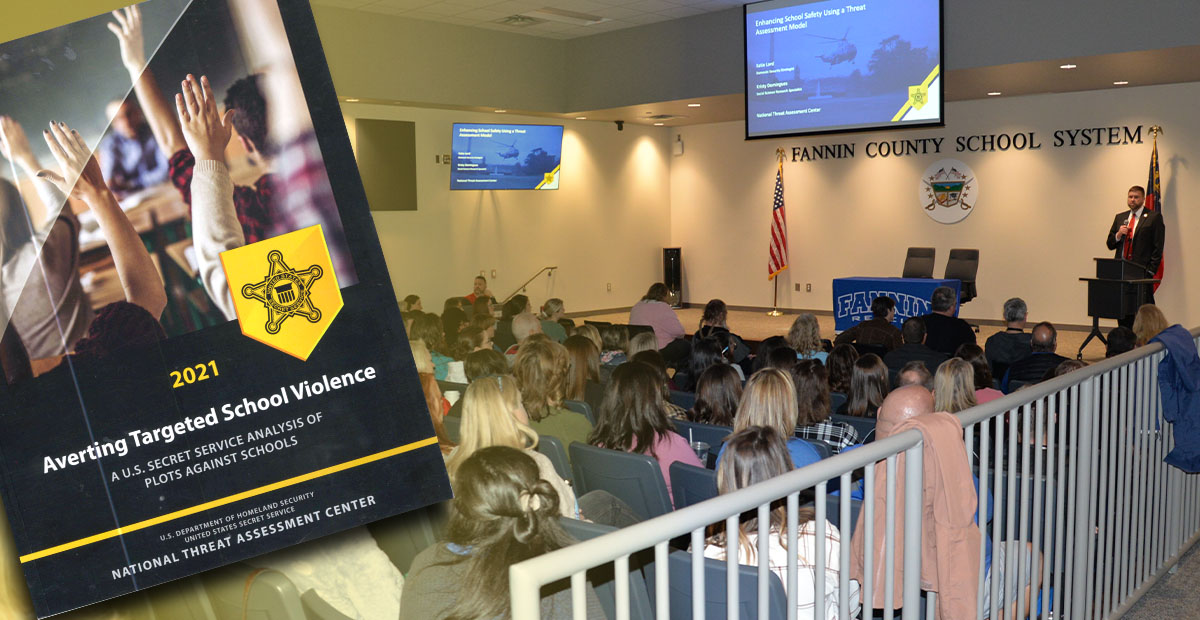
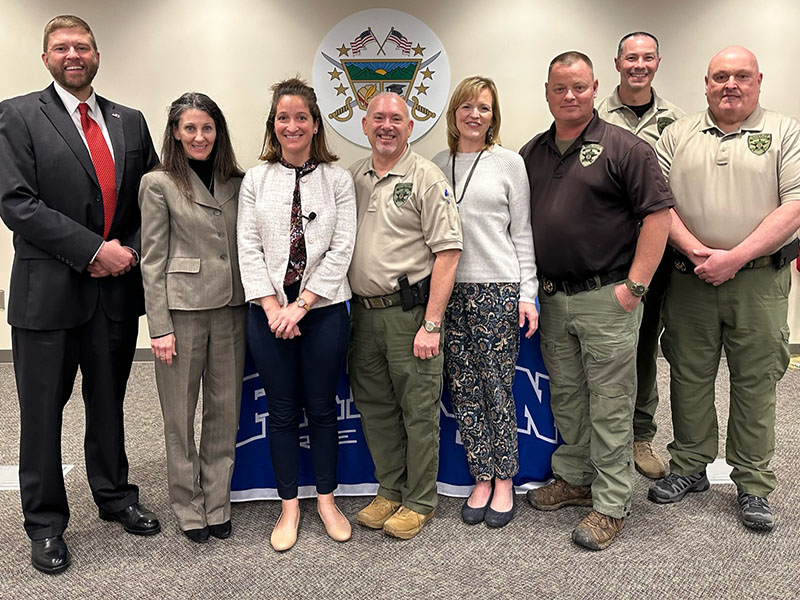
The Fannin County School System “takes on a lot of care taking roles...we look at every aspect of the student as a human being,” Shannon Miller said last week.
Miller, who is the system’s executive director and upcoming superintendent, was referring to the reason behind part of the system’s staff development training held before students returned from the holiday break. Part of the training focused on the need to be proactive in order to stop any possible violence.
Katie Lord and Kristy Domingues of the United States Secret Service National Threat Assessment Center talked about what has been learned from previous school attacks and what to look for in potential threats. Lord is a domestic security strategist and Domingues is a social science research specialist.
Lord said the old “you can see it coming” method of assessing a threat is not true. This included looking for a mentally deranged person who was about to snap, someone always depressed, or possibly a loner who stayed away from everyone else. There was also the old idea that school violence was random.
“There is no profile of an attacker,” Domingues said. “Get an image in your mind and get rid of it. Don’t make assumptions.”
National research has shown that school attacks result from targeted violence that is planned out over a period of time. The person or persons carrying out the attack is generally not related to any other criminal activity.
There are also other misconceptions about school violence. For instance, while some people believe firearms are the only weapons used in school attacks, they are only used in 61 percent of instances. A full third of attacks involved bladed weapons, and the attack that resulted in the most injuries involved a bladed weapon. Attackers have also used a bo staff and claw hammer.
Nearly three quarters of attacks target one or more specific persons, not masses of individuals.
83 percent of attacks are over in five minutes or less, and among those 75 percent are over in two minutes or less and 44 percent of attacks last less than one minute.
The national center’s research was used to teach school staff how to identify a problem before it happens.
Lord said the goal is to determine, “how can we prevent” an attack by convincing a student not to use violence as the answer to solving a problem.
Domingues said this involves identifying, assessing and then intervening in a student’s behavior.
To accomplish this, Miller said school staff has “to be involved in the child’s relationships.” Teachers have to know what affects students beyond the classroom.
She said teachers already know their students and have relationships with them through regular contact. The training was designed to “educate our teachers on student behaviors” and what can bring about behavioral changes.
“We need to get to know our kids better,” Superintendent Dr. Michael Gwatney said.
As part of relationship building, Fannin educators also learned that anyone planning an attack will often talk about their plans with other students.
Lord said students who hear the threats will only “tell” based on the school atmosphere. Students have to have a trusted adult, know their voice will be heard and that their information will be shared.
This was stressed to the Fannin school staff.
Miller said students, parents, everyone, is always encouraged to share any knowledge about a potential attack, and a variety of options exist.
She said, “Students can always tell a teacher, coach, counselor, administrator or even a bus driver...any adult they trust in the system. What our students tell us is always taken very seriously.”
Adults are encouraged to call an administrator, parent liaison or staff member at the child’s school.
There is also an app on the system website to report a safety issue.
But if a threat is imminent, call 911.
Anyone who reports a problem can remain anonymous.
“Our students are our children. We do everything we can to make sure they are safe,” Miller said.