
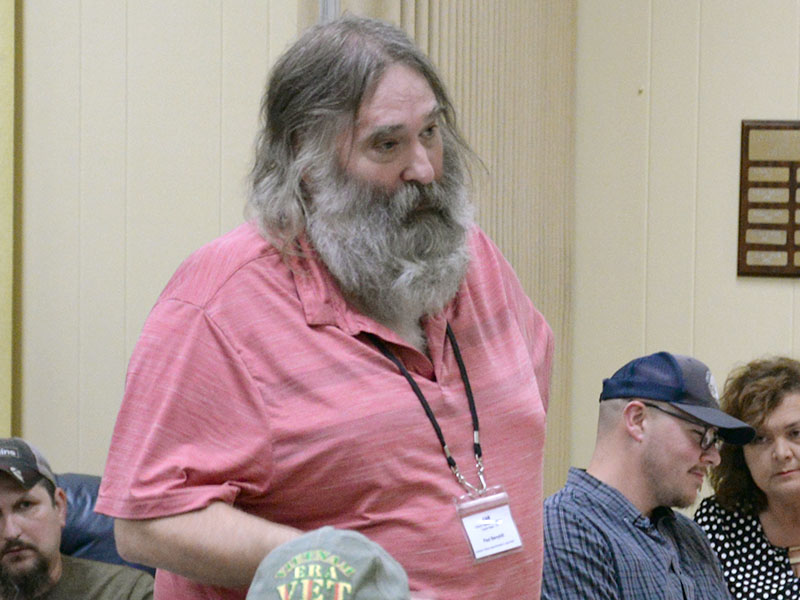
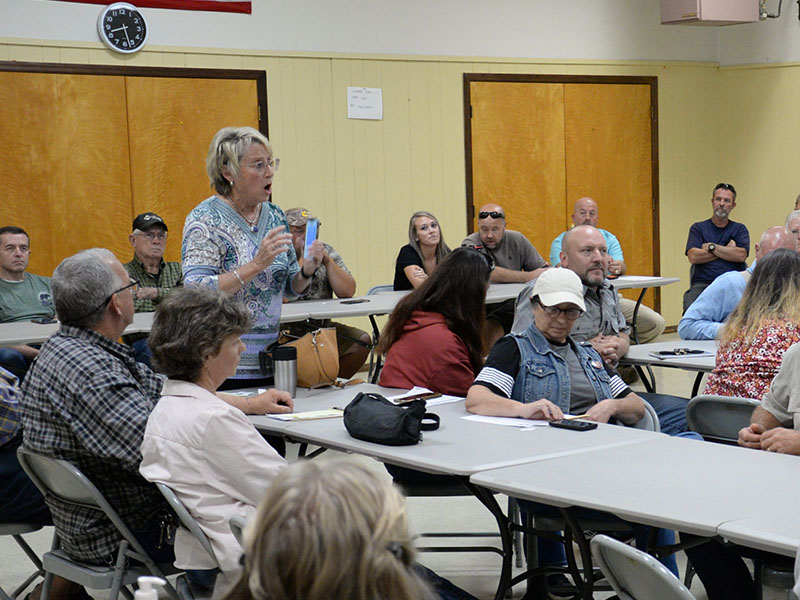
esidents of the Copper Basin and surrounding communities came together Tuesday evening, September 13, at the Polk County Commission meeting to question Copperhill Industries, LLC, (CHI) and the Tennessee Department of Environment and Conservation (TDEC) about future plans for the use of biosolids on the company’s property near Copperhill.
After the introduction of each county commissioner, TDEC employees wanted to present the information they had set out for the meeting to give the public an idea of what biosolids are and what they do.
Megan Paulk, with the TDEC office of External Affairs, opened, “Over this past summer, we have received a lot of comments from folks in the community about biosolids, odors and composting...I just want to make sure we’re all on the same page when it comes to the composting activities at Copperhill.” She went on to say that the composting permit had in fact been withdrawn August 20 of this year.
Presenting the biosolid information was Bob Odette, with the Division of Water Resources at TDEC. He talked about what exactly biosolids are, state and federal regulations, along with the health, safety and quality of life issues caused by biosolids, specifically odor in this case. He stated, “There are benefits aspect of biosolids that we want to talk about...has to be done right, has to be managed properly, but there are benefits.”
Each person who attended the meeting who wished to speak was given a number at entrance so that everyone who wanted to speak would be able. Commision Chairman Greg Brooks stated, “Last time, I kept feeling like I wasn’t calling on everybody...I want everybody to get to speak...where nobody gets looked over.”
During the lengthy public commentary, many community members approached TDEC and CHI with questions and statements about their concerns for the future of the Copper Basin.
Jeremiah Jack, with the McCaysville Wastewater Treatment plant, made several points with concern for how the spread of biosolids would affect the local environment as well as the people of the community. Jack stated, “I care about my community...I love this land, I love these people around here, love the people in McCaysville...anyone that doesn’t care anymore than that about these folks should be ashamed of themselves.” He went on to encourage the public along with the county commissioners to contact elected state officials with the intention of creating a law to ban the use of biosolids in the state of Tennessee.
Troy Keith, with the Division of Remediation, responded, “I liked the speech.” Odette quickly disagreed stating that misinformation can be easily found on the Internet. Jack said, “A lot of what I found was actually on the EPA (Environmental Protection Agency) website.”
Speaking in support of the Ocoee River community, Ann V-Meek talked about the negative impact on tourism, an essential source of revenue for the Ocoee River, created by the use of biosolids. She stated, “We’ve been smelling it (biosolids) for a while...I’m still seeing big trucks going in and out...it’s impacting the businesses.” She said that recent customers of hers who she recommended go to Copperhill for dining later reported back to her that they chose Blue Ridge for dining instead due to the odor of Copperhill. She asked what the expected timeframe would be for the odor to stop.
Keith responded, “There’s a timeline...once that is established, you’re done...people that don’t do this for a living try to put it in perspective.” He went on to say that everyone has a one in three chance of dying from natural diseases like heart attack, stroke, cancer, etc. He said, “When we look at these contaminants that are detectable, we’re talking about a cleanup standard at regulatory threshold that if you eat this every day for 70 years, you’ve got one person out of every hundred thousand that will have excess cancer from that.”
Not satisfied with Keith’s response, V-Meek asked to speak to a representative of CHI to better answer her question regarding how long it would be before the odor would no longer be an issue and why trucks were still being transported in and out of CHI even after the withdrawal of the composting application.
Sara Mickens, who has identified herself as the project manager for the biosolid work at CHI, responded, “I am a native. I love my town; I’ve always been here...I lived in Coletown for over 20 years.” Mickens said that everything they receive is from Chattanooga. Karen Styers, representative of Moccasin Bend Wastewater Treatment plant, said that there was a contractor error that allowed them to receive a shipment in August, but the last scheduled shipment was in May.
Mickens continued, “Speaking on the trucks that are still going in and out, there is another business there at Copperhill Industries...there’s lot of gravel trucks, there’s still recycling of other materials that are on the site.”
Styers said that they (Moccasin Bend) have not brought anymore biosolids, and there are no future plans to bring in anymore biosolids “until the amount that is on-site has been spread, then a remediation officer will need to inspect the site...and they will make the recommendation on whether more material is needed.”
Public questions continued for over an hour. People of the community were mostly concerned with the odor, the effect of biosolids on the environment, the economic standpoint for Copperhill and McCaysville, property values, and the concern of CHI not informing the public during the beginning of the biosolid project.
Polk County Commissioner Samantha Trantham asked the TDEC members, “If we were, as a commission, to do a resolution to stop biosolids in Polk County, and we had to send it to legislation, how fast could that permit be pulled?”
Keith responded to the commissioner that the biosolids are “permit exempt” unlike the composting permit that CHI recently withdrew from.
Polk County Commission Chairman Greg Brooks brought tourism to the table stating, “Bottom line, this county is a tourism county and a retirement community...I don’t think people here want it, and they’re gonna do whatever they can to get it stopped.”
Public participation is a component that TDEC has to consider according to Keith. He said, “It’s pretty loud and clear where ya’ll’s sentiment is.” Keith said that his recommendation to Nashville would be to “reconsider the use of biosolids...that’s my honest recommendation.”
The commission board voted in favor of a resolution banning biosolids at its Thursday, September 15, meeting in Benton. (See related story).