
T
he year was 1982 when Oscar Henry approached Fannin County commissioners with a proposal for the county to take over the ambulance service from his funeral home.
Soon afterwards, commissioners agreed, the ambulances moved across the street and Darrell Payne came with them.
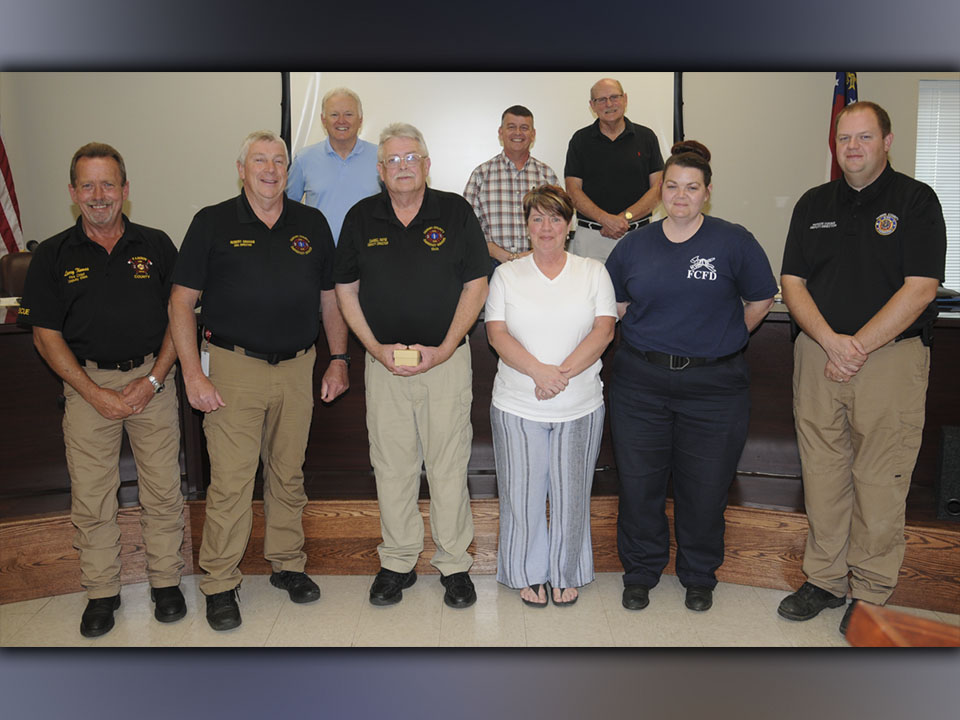
Payne was one of Fannin County’s first Emergency Medical Technicians (EMTs) and now, with 38 years of continuous service, he is retiring as deputy director of the county’s Emergency Management Agency (EMA) and director of the county’s Emergency Medical Service (EMS).
Payne’s retirement was announced officially at the Board of Commissioners meeting Tuesday, June 22.
Thursday morning, Payne and EMA Director Robert Graham looked back over the last 38 years, changes and growth in Fannin County’s EMS.
Graham was the county’s Civil Defense director when Henry made his ambulance service proposal.
The county service started with two van-type ambulances and a high-top Cadillac unit, and was located in the old Chevrolet dealership building on the corner of West Main and Church streets.
Seven paid employees manned the ambulances seven days a week, 24 hours a day.
Graham remembered how crews worked 24-hour shifts, were on call the next 24 hours, and then had 24 hours off.
One ambulance, manned by one crew, was on duty at a time. But if that crew got a call, the on-duty crew was called in. Payne said that often meant employees worked 48 hours at a time.
Transfers to big city hospitals were always done by ground, Payne said. There were no helicopter services.
Taking an emergency patient from Fannin Regional to Atlanta would usually take about two hours and 15 minutes, running lights and sirens all the way, Payne said.
The route went all the way south on what is now Old Highway 5 until reaching Marietta. He remembered how city police officers would block intersections and stop traffic along the route to allow an ambulance to pass quickly. He can remember going through downtown Ellijay at 80 miles per hour.
Payne also told how, if a patient was critical, “in real bad shape,” a doctor would “jump in” the ambulance and ride along.
Payne said Dr. Richard Vollrath was the last physician he remembered taking such a ride.
One of the few perks of a transfer was the Varsity in Atlanta was used as a landmark for one of the major hospitals. If there was time, seldom did a crew pass up a chance for a meal there.
One of the biggest changes in Payne’s first years was the installation of the 911 system in Fannin County.
Graham gave credit to Thomas Jones who donated the equipment for the system, making Fannin County the first county in North Georgia to offer the service.
That system was basic, primarily in place to reduce the amount of numbers a person would have to call to get emergency help. It was a great advantage in those days, Graham noting how telephone dialing in the area had increased from four to seven digits.
The level of care provided by ambulance crews has also changed greatly during Payne’s tenure.
When the county took over the service, citizens were accustomed to little more than “load and go” – getting a patient into the ambulance as quickly as possible and getting the patient to the hospital.
Payne remembered how, on one of his early Fannin County calls, he was bandaging an elderly woman’s head who had fallen in a garden before taking her to the hospital. He had to convince her husband that he was taking care of her before transporting her.
In 1976, when he was still a teenager in high school, Larry Cochran of the Sequoyah Trail Rescue Squad in Polk County gave Payne a book, “Transport of Sick and Injured.”
Payne credits Cochran and Toby Pickelsimer with making sure he read that book, which led him to a career. “I figured out this might be something I wanted to do,” he said of his years with the ambulance service.
Those years grew from the basic care of the early days to the professional services offered today.
For instance, the EMT course in 1980 took 80 hours to complete. Nowadays, its takes about a year of schooling to earn EMT certification. It’s not uncommon for a paramedic to spend two years in school.
Out-of-town hospital transfers, especially in critical situations, are done by helicopter. Patients reach larger hospitals in a matter of minutes, not hours.
Patients were once surprised by a bandage 38 years ago, and hospitals were adapting to how much care a patient could receive. Patients now receive everything up to and including cardiac drugs. When an ambulance arrives at an emergency room, and “you don’t have an IV started, (a very basic step in patient care) they’ll ask you why,” Graham said.
Fannin County now has four, manned ambulance/fire stations and can man as many as seven ambulances at a time.
Payne has lived through all these changes and is credited with being responsible for many of them, Graham said. They agree all the changes have “been for the good of the patient.”
Payne was promoted to EMS director in 1990. Over the years, he has also served as EMA director four times. He has also been a member of the Region 1 EMS Advisory Council since 1989.
Looking forward to retirement, Payne said, “It’s time to step back and enjoy life.” His plan? He’s looking forward to spending the summer with his daughter Scarlett as the first step toward that new goal.