

Medical professionals agree that time is a critical factor in the successful treatment of someone who has suffered a stroke.
The partnership between a Fannin County Emergency Medical Service (EMS) ambulance crew, Life Force and Kennestone Hospital recently set the perfect example of time and technology going hand in hand, resulting in a stroke victim’s speedy recovery.
A “perfect storm” began unfolding recently when the Fannin County 911 Center received a call at 12:40 p.m. An 88-year-old female had been found by her daughter suffering from right facial droop and right side weakness.
Fannin County EMS Director Becky Huffman, the paramedic who answered the call, said the victim scored an 18 on the NIHSS scale, the system used to measure a stroke’s severity. The patient had no speech and no right side movement.
Based on the age of the victim, this level of stroke would have usually left her confined to a nursing home for the rest of her life, Huffman said.
Having assessed the patient’s condition, Huffman made the decision to have the woman flown directly to the Comprehensive Stroke Center at Kennestone Hospital.
She had Daniel Elford, the Advanced Emergency Medical Technician on the call, call for a Life Force helicopter before the ambulance left the patient’s home.
Life Force 4, the Life Force helicopter based in the Fannin County Industrial Park just outside McCaysville, was waiting at Fannin Regional Hospital when the ambulance arrived.
Just before 2 p.m., the helicopter arrived at Kennestone Hospital in Marietta.
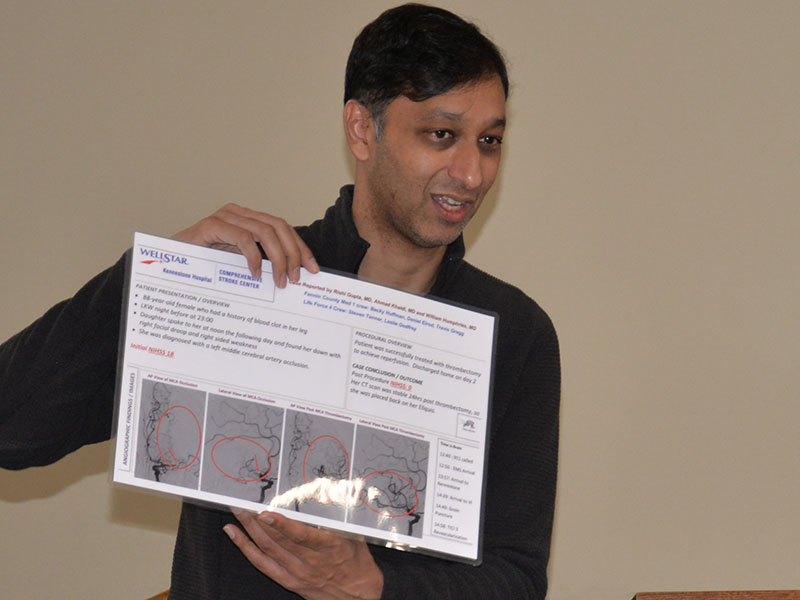
Looking over the timeline, Jennifer Jones, EMS coordinator for Kennestone Emergency Services, explained how barely more than two hours after EMS arrived on the scene in Fannin County blood flow had been restored to the woman’s brain at Kennestone Hospital.
Folllowing the procedure at Kennestone, the patient’s NIHSS score dropped to 0, indicating no effects from the stroke, and the patient was discharged to go home on the second day.
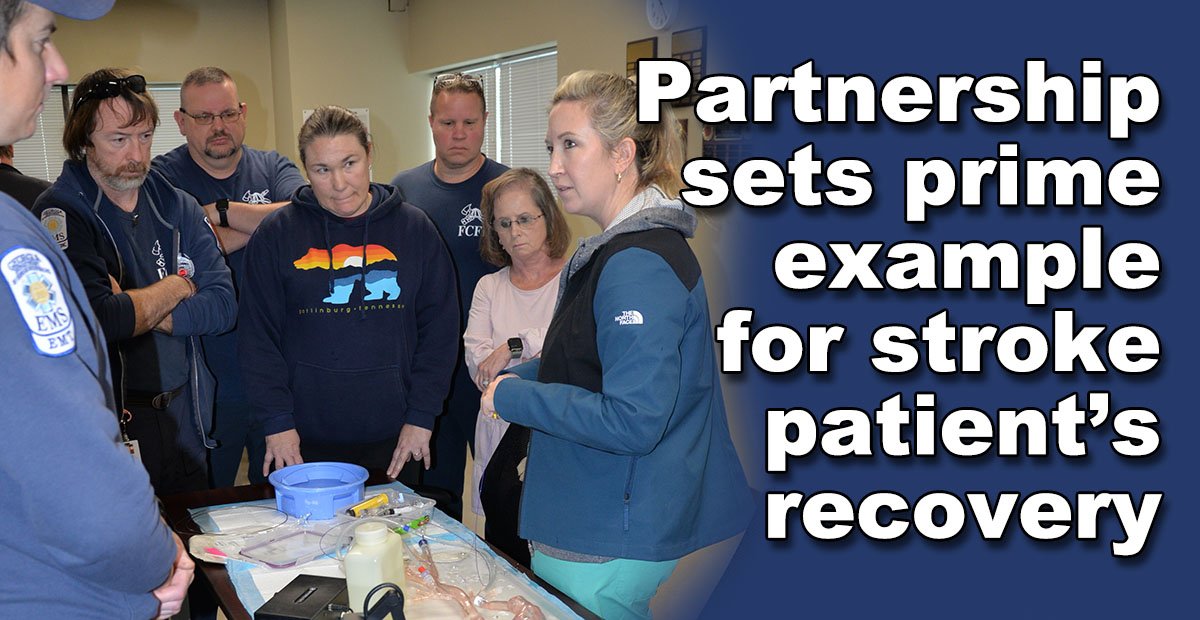
The experience was used Friday, December 2, as the catalyst for training sessions in Blue Ridge.
Two doctors from Kennestone Hospital presented the latest technology that is used by the hospital in the treatment of cardiac and stroke patients.
Dr. Rishi Gupta concentrated on advances in stroke care that resulted in the outcome for the Fannin County patient.
He explained how a thrombectomy was performed on the patient. This is an innovative surgical procedure used to remove blood clots from arteries and veins. A surgeon inserts a catheter into the patient’s blood vessel to remove the blockage and restore blood flow to the affected area.
Gupta explained the various time windows when a stroke can be treated, preventing debilitating effects for the patient.
For instance, in the Fannin County case, the window had passed for the use of TPA clot-busting drugs. The thrombectomy was the next step, and is a procedure offered only at comprehensive stroke centers.
Stressing the importance of care as quickly as possible, Jones said that, in cases of a stroke, two million brain cells a minute are dying, and the brain does not reproduce these cells.
The success of this outcome has Fannin County EMS re-evaluating its transport destination protocols – the policies that determine where to take patients based on their condition.
Jones said the outcome for the 88-year-old woman was the perfect example, the “perfect storm,” of why stroke patients should be taken directly to a comprehensive stroke center.
Part of Gupta’s presentation was to help explain to Fannin County EMS employees how to make the decision to send patients straight to such a facility. “You have the expertise to make this happen,” Gupta said.
“We’re trying to look out for the patient,” Jones said. The technology used for the Fannin County patient has “prompted a whole new movement” in patient care.