

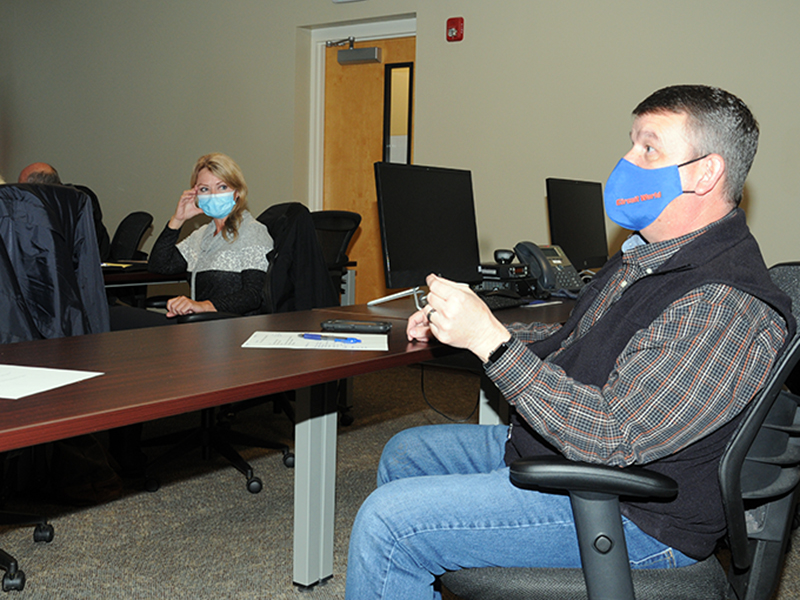
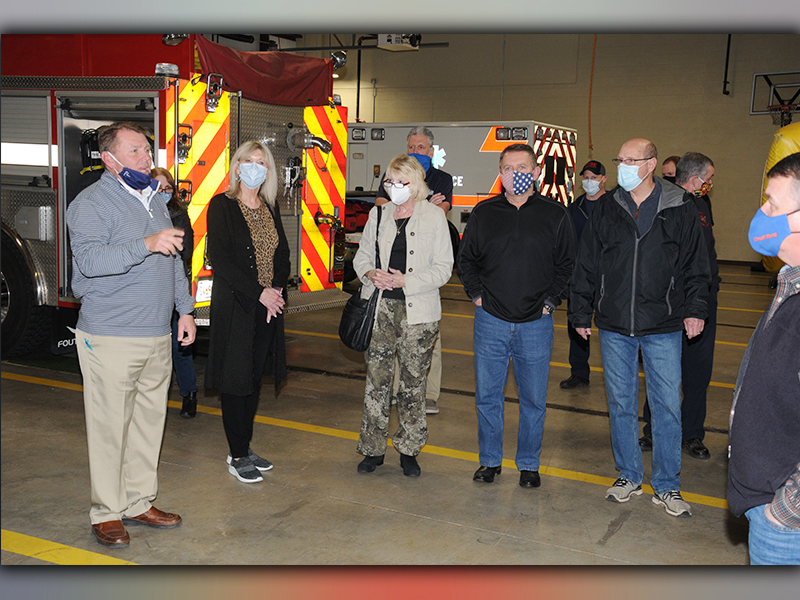
Promising the session would be educational and informative, volunteer firefighter/EMT Kevin Panter opened a meeting with representatives of the Fannin County Fire Department, Fannin County commission, and the city councils of Blue Ridge and McCaysville Thursday afternoon, February 11, in Blue Ridge.
The meeting was originally planned to concentrate on the Blue Ridge leaders following a city council meeting Panter attended, but was expanded to invite other local government officials.
Panter, along with fire department Training Director Dale Stiles, were joined at various times with comments from Fire Chief Larry Thomas and Emergency Management Agency Director Robert Graham as all sought to explain the equipment used by the department, how Insurance Service Office (ISO) ratings work, ways government can help, a shortage of volunteers, and the equipment the department needs.
Those attending were first given a test to check their knowledge with questions ranging from the amount of hose a fire truck carries to the effect of a change in the ISO rating.
After going over the number of county fire stations and the equipment at each, Panter said, “All this stuff we’ve talked about today” is considered in ISO ratings. Staffing, training, equipment and available firefighters make up the largest portion of the ratings, while available water supply is also a huge factor. Other considerations are quality of the 911 system and programs such as community outreach and fire prevention education.
Panter then explained how the recent increase in Fannin County’s ISO rating resulted in homeowners insurance rates increasing by an average of 15%.
As questions came from the audience, Blue Ridge Councilwoman Rhonda Haight asked about fire inspections after hearing an example of a fire downtown that would likely not have happened had there been an inspector.
The state is involved in certain commercial inspections, but there is no local inspector.
Commission Chairman Jamie Hensley asked what was necessary to have an inspector and was told by Thomas manpower was the first hurdle.
It was then Hensley asked, “At what point in time do we start being pro-active? I’m trying to figure out what I need to do to make this happen. We need to start thinking and looking.”
Graham said two weeks training is required and the candidate must hold a firefighter certification. The training is free, but the county would have to pay room and board. He also said a local ordinance is needed.
Such an ordinance would give the inspector enforcement powers to issue citations, which would result n fines, for non-compliance.
Both the county and city would have to adopt ordinances.
Panter also talked about ways government could help by purchasing equipment and hiring more firefighters. He said volunteers are fewer and fewer, but had high praise for the dedication of the current group.
Stiles said firefighter certification involves 360 hours of training, which takes place over four to five months, along with a two-month basic first responder class. Afterwards, there is a yearly training requirement of 24 hours.
Panter also addressed fire hydrants, showing officials things to look out for that hamper firefighting such as poor placement and locks on the hydrants. He said both slow efforts to obtain needed water at fire scenes.
Panter concentrated on examples from the Blue Ridge system, but said improvements are needed in McCaysville, too.
Having learned of Panter’s comments, Blue Ridge Water Supervisor Becky Harkins sent an email to The News Observer Friday morning saying the hydrant locks the city uses were approved by the fire department before they were installed.
She also said the city is fixing hydrant issues as they are reported, but three examples Panter used had not been reported. She also noted one example, a hydrant in the Overlook subdivision that is barely accessible, doesn’t belong to the city.