
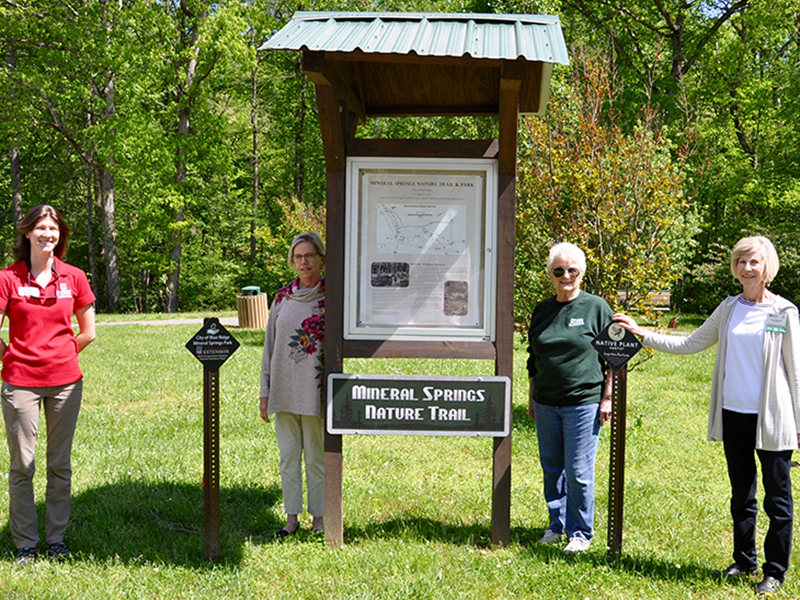
“How exciting it is from an extension agent standpoint that Master Gardeners took this, ran with it and created something, an outdoor laboratory where we can have lessons and engage young people and old people alike,” Fannin County Extension Agent Ashley Hoppers said of Mineral Springs Park.
Mineral Springs Park was accredited a Gold Level Native Plant Habitat Certification by the Georgia Native Plant Society and the University of Georgia’s (UGA) State Botanical Garden of Georgia back in September.
“Our big reward was the Georgia Native Plant Society certifying this park,” Fran Stoecker, North Georgia Master Gardeners Extension Volunteers (NGMGEV) president, said.
While evaluating the park, a representative from UGA came out.
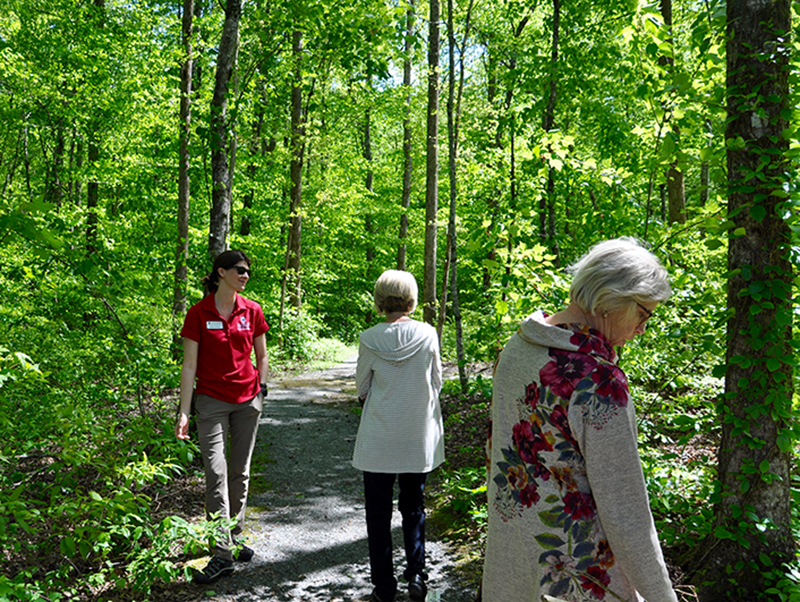
“She’s walking through the park, and she sees all of the horrible invasives, but then she started spotting all the native plants, and then she started getting really excited because she said, ‘This has not been touched for a long, long time,’” Alyce Wirtz, NGMGEV project chair, said. “She took one walk through it and said, ‘Gold.’”
To achieve a gold level, a park must have at least 75% native plants while promoting biodiversity.
A grant came with the certification, which was used to purchase more native species and other materials.
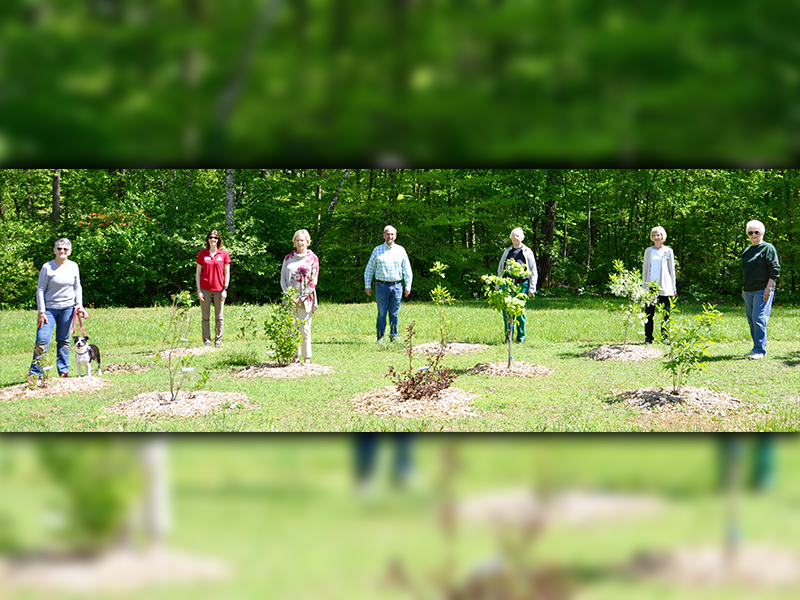
“It’s the framework for an arboretum,” Hoppers said. An arboretum is a botanical garden devoted to trees.
“It’s just endless discovery out here,” Hoppers added. “And it’s just a really amazing project that I think will keep going up and up and up.”
NGMGEV began working on the park some two and a half years ago, Stoecker said.
While the City of Blue Ridge is responsible for the actual pathways, the master gardeners take credit for the beautification.
Before the gardeners began working on the park, the whole area was stricken with invasive plants like kudzu, Chinese privet and Japanese knotweed.
“The invasive plants were really taking over,” Stoecker said. “This year, we’ve seen plants we’ve never seen before.”
Today, however, many native plant species are thriving since the invasives have been removed, mostly.
Invasive plants like kudzu are hard to get rid of, Stoecker said, but the group is staying on top of it all.
When walking the park, the native plants, like sweetshrub, cinnamon fern and ginger, can easily be identified due to signage created by NGMGEV Charlotte Dickinson.
“The city has worked with us because when we first took over they came in, and there was a lot of trees down, and they pulled up things that were down,” Stoecker said. “They provided us the man power, the herbicides, and heavy equipment.”
As of now, the gardeners have mostly worked on parts by parking lots.
Blue Ridge’s mineral springs were once a staple of the town.
Many believed that drinking the water from the springs was beneficial to one’s health due to the magnesium, iron and sulfur found within.
In a time before air conditioning and other modern luxuries, people would travel by train or horse and buggy to come bathe in the springs, according to Wirtz.
When observing the springs, a rainbow like film may appear on the water. There’s no need to fear, however, as this is the minerals coloring the water.
Residents are welcome to come walk or use the area as they please. Please remember to “leave no trace.”
Native plant walks are held in the park a couple times a year, Stoecker said.
In the future, the master gardeners and Hoppers hope to use the park for a variety of educational lessons and activities.
“This park just excites me,” Hoppers said.
Contact the Fannin County UGA Extension Office at 706-632-3061 to learn more or to get involved.
“These ladies work really hard out here, it’d be nice to have some more, you know, young, strong backs out here pulling stuff and learning, ideally,” Hoppers added.