
E-SPLOST, positives, state level plans talked

The group gathered for the annual Eggs & Issues Breakfast Friday, September 29, heard a long range prediction of the state’s job market, but not before local leaders gave a look at issues closer to home.
School Superintendent Shannon Dillard-Miller stressed the importance of the Special Purpose Local Option Sales Tax for Education (E-SPLOST) to the future of education.
She said the tax is vital as school leaders work “to provide opportunities for the children in our county to live out their dreams.”
Part of that effort is to make sure “every high school graduate (is) able to be workforce ready,” Dillard-Miller said.
The superintendent explained this is not to discourage college educations, but to make sure graduates can get a job when they leave the local high school.
Passage of the E-SPLOST in the November 7 election is critical to this mission as it will fund a new Career, Technical and Agricultural Education (CTAE) building at the high school and many other education needs.

Collections of the five-year extension of the current E-SPLOST are capped at $53 million. If extending the tax is not approved, school officials will be faced with increasing property taxes or reducing educational opportunities offered to children.
Fannin County Commission Chairman Jamie Hensley urged everyone to “look at the positives in our county.” He talked of the strides that have been made in public safety and public works over the last three years as county government “works everyday to catch up with the growth that has passed us by.”
The commission chairman noted the new fire station being built in Epworth and the new station being planned near Blue Ridge Medical Center (formerly Fannin Regional Hospital). He was also quick to point out Fannin County is out of debt.
Hensley called for “unity in the community” to continue to build on the positives that exist.
State Representative Johnny Chastain called the SPLOST “the best, most fair tax we’ve ever had.”
Looking to the needs of Georgians statewide, he told of a recent state government survey that revealed 30% of the population are most concerned about the economy. Also noted were 20% are most concerned with crime and public safety, 11.2% with Second Amendment rights, 6.7% with education, 6.7% with health care, and 6.4% with infrastructure.
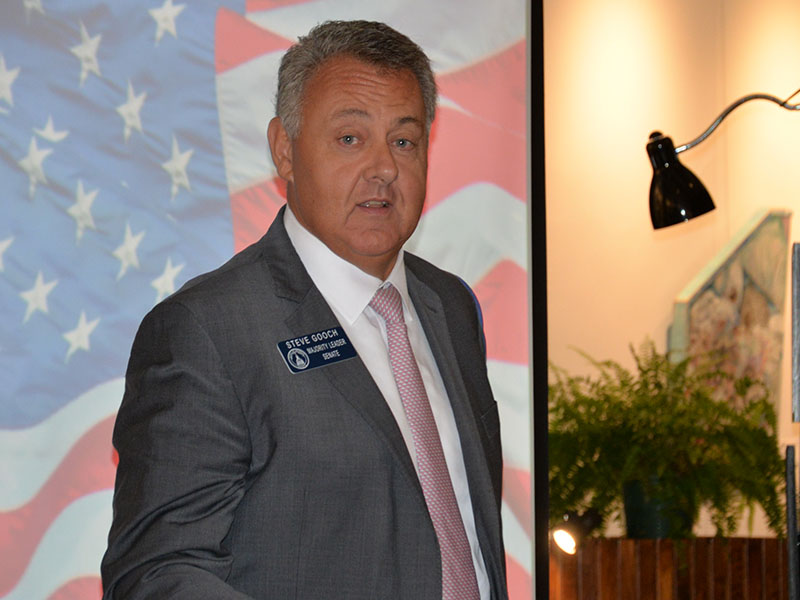
State Senator Steve Gooch told the gathering, “We live in very interesting times.”
While also bragging on Fannin County and Georgia as a whole, he said, “Everybody’s world can always improve.”
Two issues facing the next legislative session are insurance premiums and tort (judicial) reform.
He asked how many had seen their insurance premiums increase dramatically, and said this was happening all over the state and hurting Georgians.
He said Georgia has the “worst judicial rating in the country,” a situation legislators want to improve.
Eggs & Issues, sponsored by the Fannin County Chamber of Commerce, was held at The Art Center in Blue Ridge.
-------
School must prepare students to enter Georgia’s workforce
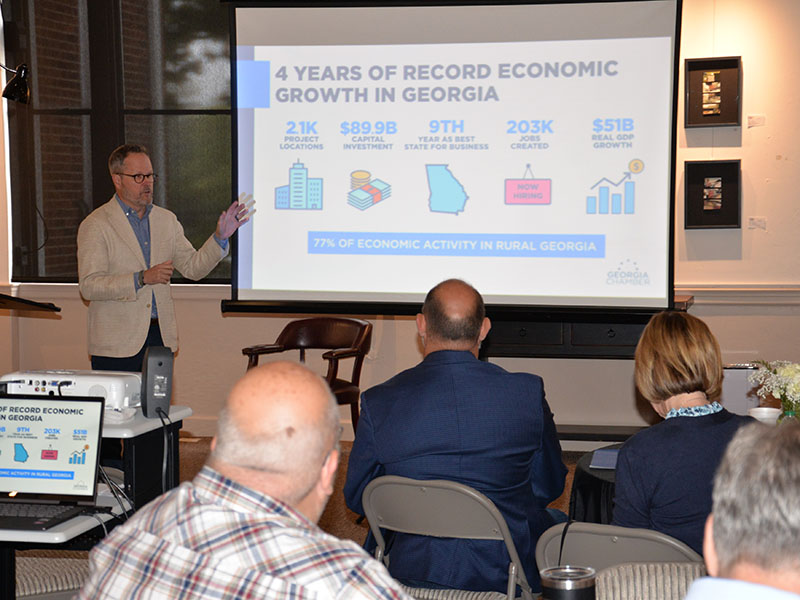
Chris Clark told local leaders what they already know, that finding employees is more difficult than it ever has been.
Clark, president and chief executive officer of the Georgia Chamber of Commerce, was the keynote speaker at the annual Eggs & Issues Breakfast sponsored by the Fannin County Chamber of Commerce.
“There are people that should be working that aren’t working,” he said, which falls on the heels of four years of record economic growth in Georgia. And 77% of that growth has occurred outside Atlanta, reversing the historical trend.
The are currently 3.2 million Georgians eligible to work who have made the decision not to work, Clark said.
One of the largest groups of these is women, who face obstacles placed by child care and elder care.
But a big part of the problem comes from disrespect, Clark said.
Womens’ choices not to work hurts two primary workforces, nurses and teachers.
“We don’t respect teachers anymore,” referring to students and parents alike.
He told of nurses constantly spat upon and cursed by family members of patients.
He warned of the crisis in the health care industry where there are currently 46,000 job openings, by 2028 there will be 61,000 and by 2030 there will be 101,000 unfilled positions.
The other group in the category of choice are middle aged men. Opioid addiction and their loss of the skill set they had used since starting their careers are keeping them out of the workforce.
But Clark said there are men and women who want to work, employers just have to search them out. Among these are individuals who need a second chance, those who have been incarcerated and are looking for jobs.
He also said people with disabilities are looking for jobs, employers must simply work a little harder to accommodate them.
Refugees who are hired represent a 90% retention rate for employers.
Another group of willing and able workers are foster kids, those who have aged out of the foster system and now must find employment.
He encouraged employers to look at these individuals as they fill open slots.
Then there are the unemployed. While Georgia has a 3.2% unemployment rate, the unemployment rate among college graduates is 5.8%. Clark said young people have been told for 20 years they must have a college degree to get a good job, and now they have degrees that aren’t taking them down that path.
“40% of kids graduate high school without having worked a job,” he said. Students aren’t prepared to work. This is something that has to be changed.
Schools in the mid-West are requiring that every student have some sort of real world experience in order to graduate high school.
The Georgia Chamber president also told how, over the next seven years, artificial intelligence (AI) is expected to eliminate 20% of low paying, rural jobs.
The answer to fixing the future is to “make sure the kids coming through schools know how to AI proof themselves,” Clark said.
He said they must be trained to work and trained that low skilled jobs are merely stepping stones and not a career.
Clark urged educators to help kids get real world experience and to base their studies that will carry them into the future workforce.