

Copperhill Industries owner Buddy Haynes is adamant he has nothing to hide as he takes part in a pilot project involving biosolids.
Meanwhile, a Tennessee Department of Environment and Conservation (TDEC) official spoke directly to odor concerns recently raised by Polk County citizens.
Kim Schofinski, deputy communications director for TDEC, wrote in an email that Copperhill Industries is engaged in a pilot project to remediate the historic mining site, which entails processing material from Cobb County, Georgia, and converting it to a Class A/Exceptional Quality (EQ) material (biosolids). TDEC is aware of the process, which does not require a permit, but all the substantive requirements of a permit still apply. TDEC is helping to oversee the process.
She said Denali Water Solutions is responsible for implementing the project. An email from Denali Director of Communications Sam Liebi confirmed, “...we partner with Copperhill Industries,” but was not specific as to the company’s role in the pilot project.
Schofinski wrote, “We are aware of some odor concerns. The odors are originating from the final land application of the remaining Class B biosolids from Chattanooga’s Moccasin Bend Wastewater Treatment Plant.”
She continued that process should be completed, weather permitting, in early June and TDEC is “confident the onsite odors will be greatly resolved as a result.”
Haynes said he receives the biosolids they are Class A/EQ grade, which is defined by the federal Environmental Protection Agency as meeting “the most stringent pollutant, pathogen, and vector attraction reduction requirements under EPA’s regulations.”
He said material that is not Class A is delivered to the Copperhill facility, put under a covered shed, and the upgrading process begins immediately. Once it meets EQ standards, it is delivered to Copperhill Industries for land application.
Raising the material to those high standards includes letting it cool down for about 72 hours after an extensive heating process.
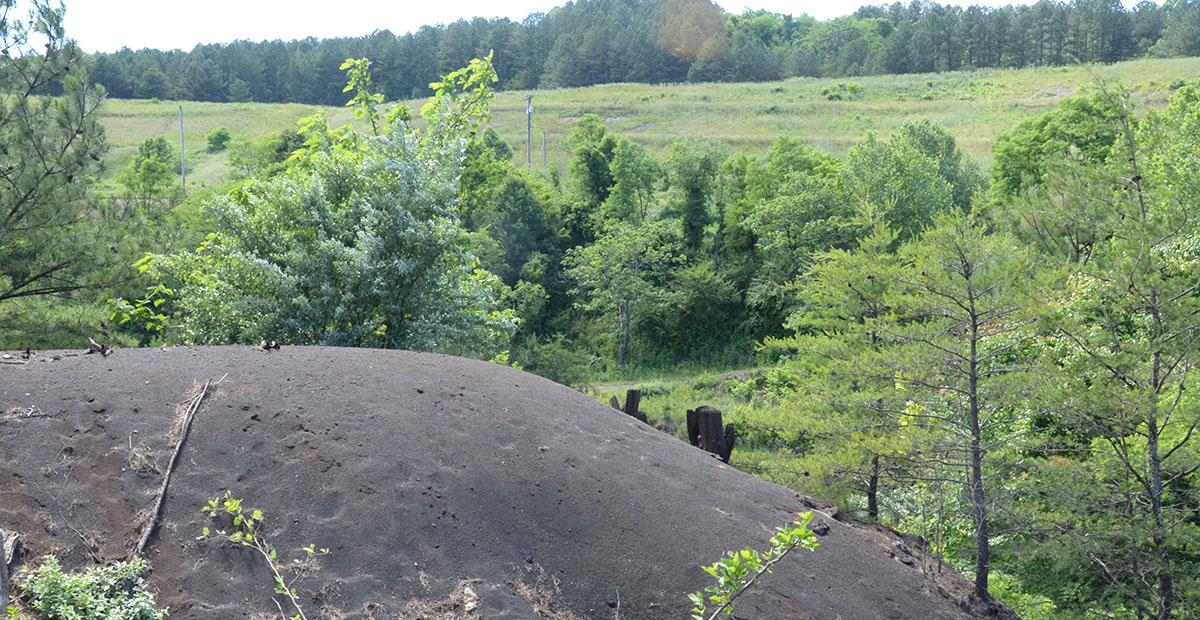
Haynes points to three sites that were nothing but waste dumps being reclaimed by biosolids. Approximately 83 of 103 acres on those once barren sites now supports vegetation and animal life.
As to water quality concerns, he said the storm water management system on the property is good enough that he stocks fish in the ponds from where water eventually flows into the Ocoee River.
He said he checks water on the site regularly, and water going into the Ocoee River is checked monthly. Regular reports have to be made to environmental regulatory officials. “The good water goes to the river,” Haynes said.
“We want to make sure nothing is going wrong,” he said.
Before biosolids, the water and much of the land now owned by Copperhill Industries rated at a pH2 to 4, leaving it far from a water quality standard of pH6 to 8 to go into the river.
Now, all water that reaches the Ocoee is at that PH6 to 8 range, Haynes said.
The U.S. Geological Survey defines pH7 as being neutral. A pH of less indicates acidity.
Why does Haynes do all the reclamation work is a question that has been repeated many times.
“I want my money back,” Haynes said.
He said that through the Financial Assurance Agreement he has with EPA, TDEC and U.S. Department of Justice, he was required to put $6 million into a trust fund when he purchased the Copperhill Industries property as part of the reclamation agreement. $3.5 million of that was in cash, the rest paid through a portion of material sales and a reduction in the scope of the work.
Before he can get any of the $6 million investment back, EPA must sign off on the completion of the reclamation agreement.
And even when this is done, if part of the reclamation were to fail, he would be held responsible to fix the problem.
As to the use of biosolids, “I have not received one red cent...for any biosolid I’ve received,” Haynes said. He also stresses it was told by environmental officials to use the biosolids because historic land reclamation measures would not work.