
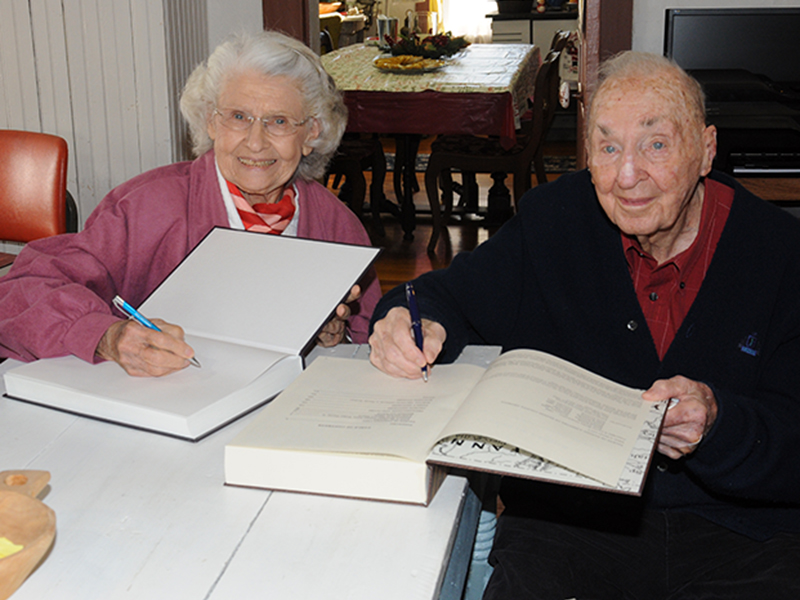
One traveled halfway across the country to make Fannin County home while the other came from just up the road in Union County. Together they formed a team that became the backbone of collecting and maintaining local history.
Ethelene Dyer Jones and Dale Dyer began work on the first of four Fannin County history books, Facets of Fannin, in 1986.
They were together again Saturday, signing those books in the Baugh House, home to the Fannin County Heritage Foundation.
Both are quick to share credit with countless others for the success of the four books which, besides Facets, relive the histories of cemeteries, schools and grist mills.
But it was Facets that laid the groundwork for all the others.
Jones remembered how the Georgia Association of Media Assistants (GAMA), a group she oversaw at Fannin County High School, did a big project every year. She was contacted by Curtis Publishing Company about producing a history book.
The Heritage Foundation had been formed in 1985 and, behind the leadership of President Stanley Daves, was an immediate supporter of the project.
The Kiwanis Club of Blue Ridge also got on board and named Dyer to co-edit the book with Jones.
Work began in 1986.
GAMA students gathered stories from their families. Parents, grandparents, anyone who had memories about Fannin history was urged to take part.
Jones is quick to credit the GAMA students for their hard work.
Dyer brags on Barbara Stilson, his secretary at Dyer Realty, for typing all the final manuscripts to be sent to the printer.
The result was the official unveiling of Facets of Fannin, 683 pages packed with family and community memories, in 1989 at the Fannin County High School Cafetorium. For those who don’t remember, that was in the years before the Performing Arts Center. The name tells the whole story, the cafeteria served as the school’s auditorium – yet another piece of Fannin history worthy of remembering.
The editors tell how 700 pre-sales were taken for the book and 1,000 copies were ordered. Dyer smiles as he remembers how, by the Monday following the unveiling, the books were sold out.
Saturday, they were signing the 11th printing of Facets of Fannin. No one could remember how many are in print, but Dyer said they “have been sold in just about every state in the United States.”
Not only was Facets of Fannin a huge local success, it took first place in several categories from history books printed all across the United States by Curtis Publishing.
It also took first place in state GAMA competition.
Next in line was the cemetery book, which was born out of a need Dyer saw in 2003.
His mother-in-law, who was a Dickey, took him to the Dickey Cemetery on Hogback Road. It is the final resting place for two of the Dickeys and their slaves. The two Dickeys, Dyer said, being the only white people there.
The cemetery was in great disarray.
Seeing this, Dyer began a project to clean up cemeteries. His weekly articles in The News Observer, which he had started writing in 1999, fueled community wide support for the idea.
Then came the desire for the cemeteries to be located and listed. Next was a project to mark all 223 that had been found with stones that carried their names.
Many people in the county, from Coopers Creek and Suches to McCaysville and Epworth, helped with the work – from cleaning to identifying.
Grover Jones, Ethelene’s husband, and Daves took Dyer to many long-forgotten locations.
Prisoners from the Fannin County Jail were used to do much of the clean-up work. Dyer remembers how, “they’d call me,” if they didn’t have a cemetery to clean.
The book was a natural extension of this effort. The copies signed Saturday marked its fifth printing.
The school and grist mill books followed.
Countless names are remembered among the contributors to all the works, but two, Jones and Dyer, are the common thread that tie them all together.
Robert “Hoot” Skelton, Heritage Foundation spokesman, acknowledged that “a whole lot of people” made every book a success, but it was Jones and Dyer who “started every bit of this.”
Without them, “starting something and taking hold, this would have never taken place,” Skelton said of the books.
But the trail of history books doesn’t end here, it didn’t end Saturday. Next up is “Fannin in the News, People, Places and Events.” It will be a collection of columns that have appeared in The News Observer, written by Jones and Dyer.
Jones has been writing for 31 years and Dyer 21. Together they have chronicled moments, many of which would have been long forgotten.
When asked how he had remembered so many details of Fannin’s past, Dyer told how he took a lot of pictures and his wife would write the date and a few pertinent facts on the back of each. His handwriting “wasn’t too good,” he said.
Dale and Ethelene have been accused, they chuckled, of being brother and sister. Ethelene, an expert researcher, says she has not yet found a bonafide kinship connection, but from all indications they hail from the Dyers who landed in Jamestown, Virginia, in the late 1600s or early 1700s.
Dale’s group went west and his ancestors include some of the original cowboys.
Some others headed south.
Dale arrived in Fannin County in 1947, fresh out of the service and newly married to a Blue Ridge girl, Virginia Hampton.
Ethelene arrived in 1960, a preacher’s wife.
Today, they are the backbone of vast accounts of Fannin history, accounts that would have been lost along the way had it not been for their dedication.