
Apples will be ready the end of July
The Dickeys are back, and they’re here to stay.
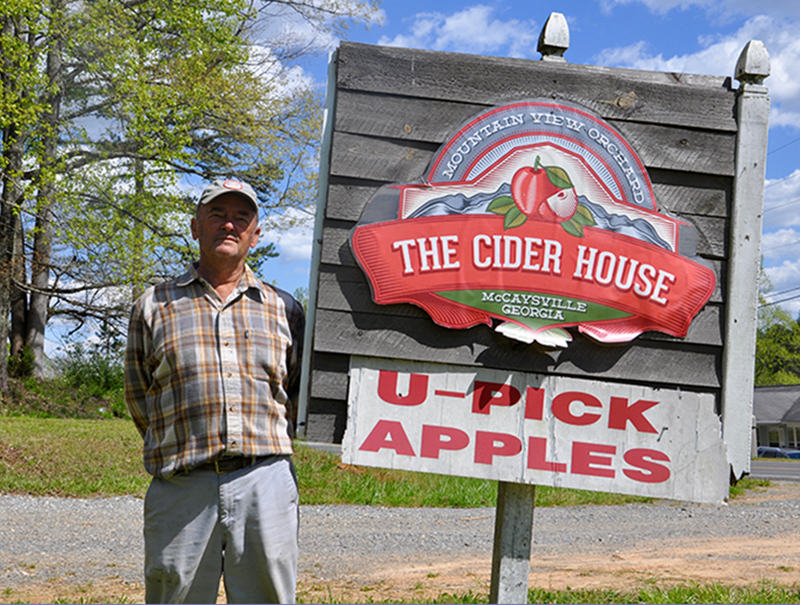
After taking an extended break, the Dickey family has decided to take back their orchard and begin harvesting their locally famous apples.
“I just love the whole system of growing apples,” Joe Dickey said. “It’s so rewarding.”
Originally, Joe and his wife, Mary Jo, planned to sell off the 12 acres, including the restaurant, and go into retirement, but after two years, they decided they couldn’t let it go.
Before the land was all that it is now, it was filled with pine trees.
Luke Dilbeck, a relative who spent most his childhood on the orchard, said, “We cleared all those pines, dug the stumps and had a great big ol’ fire. Lord, I don’t know how many a nights Larry and I sat in the basement grafting apple trees.”
Joe’s interest in apples began from a young age, he said. His grandfather had an orchard and built Joe a tree house up in a June apple tree.
“I stayed in it most the time with my BB gun,” Joe recalled. “I always said if I ever had property, I’d plant a few trees.”
Over time, a few became a few thousand.
At 17 years old, Joe planted each tree with a shovel. He began the project with just 20 trees, but after folks began flooding in to get his apples, he decided to plant even more.
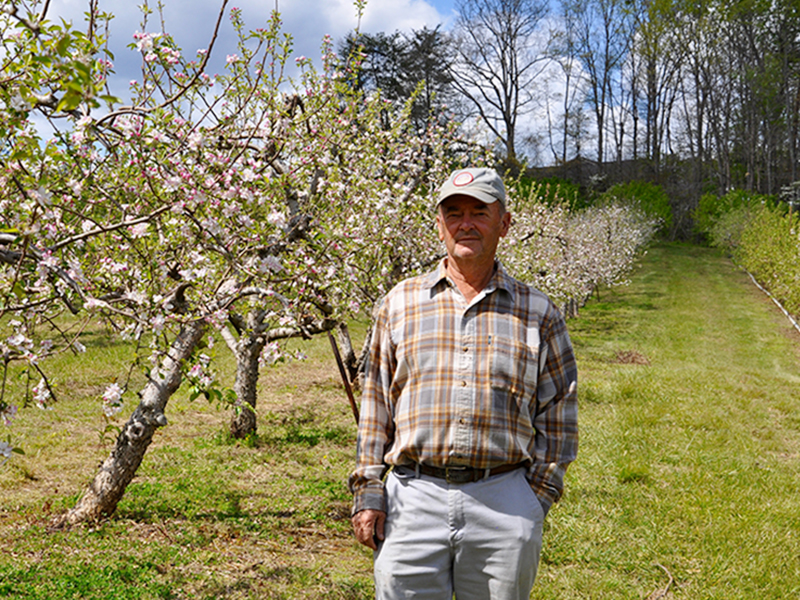
The orchard is now home to some 2,000 apple trees of 16 different varieties.
“The beautiful thing about this orchard is there’s an apple here found nowhere else in the world,” Dilbeck said.
Jonathon and Granny Smith apple trees managed to mutate together, he said.
Some of the product was sent to Adams County Nursery, where their thoughts were confirmed, this is an apple never before seen.
Joe had the honor of naming the apple and chose to call it the Joseph Smith.
Eight or nine Joseph Smith trees now reside in the orchard, Dilbeck said.
“It was amongst these trees that I cut my teeth,” Dilbeck said. “Where I ruined clothes by running through the sprinklers and sliding through the tall grass. Where in 1986, Joe showed two young kids Halley’s Comet through their first telescope and inspired a decade of space movies. Where I learned to shoot a gun and drive a stick shift simultaneously going up and down the rows.
“These trees are where I found God, where I fled to when I lost him, and where I realized that God doesn’t live in houses of brick and stone, and thus the orchard became my church.”
In a time before air conditioning, just above the orchard, on the Dickey’s property, a scenic view was, and still is, on display and Sunday worship could be heard from a nearby church.
“Whether you’re a believer, whether you’re not, there’s something about sitting on top of the orchard listening to those old, mountain songs ... It gives you chills,” Dilbeck said.
About a decade ago, the University of Georgia (UGA) came to the orchard because they noticed something unusual.
Mountain View Orchards is smaller than many, but it houses hundreds of native bees, including honey bees.
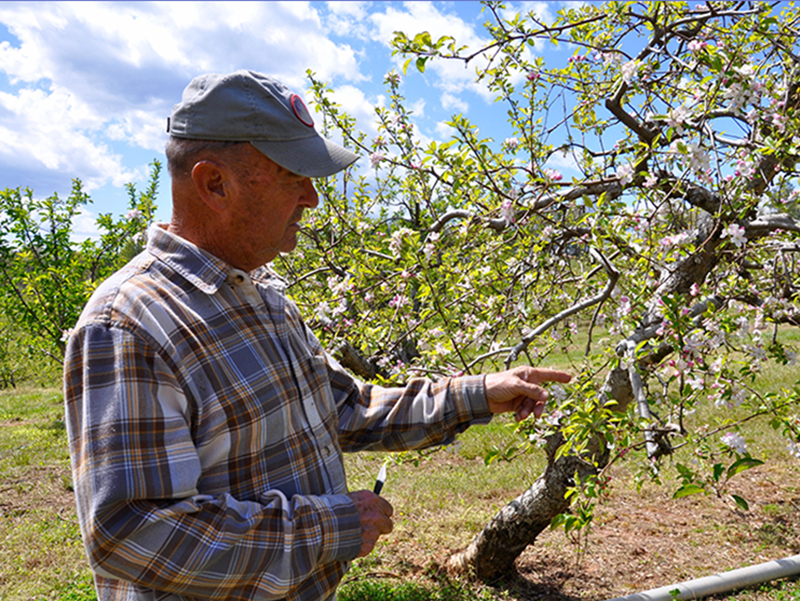
“Usually the sky will just be black (with bees) when the orchard’s in full bloom,” Joe said while shaking a tree.
UGA representatives determined that due to the amount of native bees, even if honey bees were to go extinct, the orchard would still survive.
This would not be the case for many orchards.
Joe said the reason for this is that he “doesn’t disturb the ground,” meaning he does not plow his orchard.
Adding to the intricate grove, each tree is categorized as a semi-dwarf M7.
These trees don’t get very tall, which results in “easy pickin’, easy sprayin’, easy prunin’,” Joe admitted.
“It’s a one man show just about it,” Joe said of pruning the trees.
It is usually himself doing the work, with the help of another on occasion.
Pruning the trees is very important to allow the roots to see sunlight and promote air circulation, Joe informed.
He admitted to having lost a single tree in 40 years of operation.
After a tree has been pruned, he throws the debris into the middle of the rows then gathers them all up. If this isn’t done, disease will spread that will kill the crop.
“There ain’t no place I’m happier, except maybe church, but I still say that ‘if you want something good in life, work for it,’” Dilbeck said of the grove. “That blood, sweat and tears is what creates the passion that’ll keep ya going when you gotta get out there and fix a busted water line for your sprinklers at 4:30 in the morning when the thermometer is dipping down below freezing.”
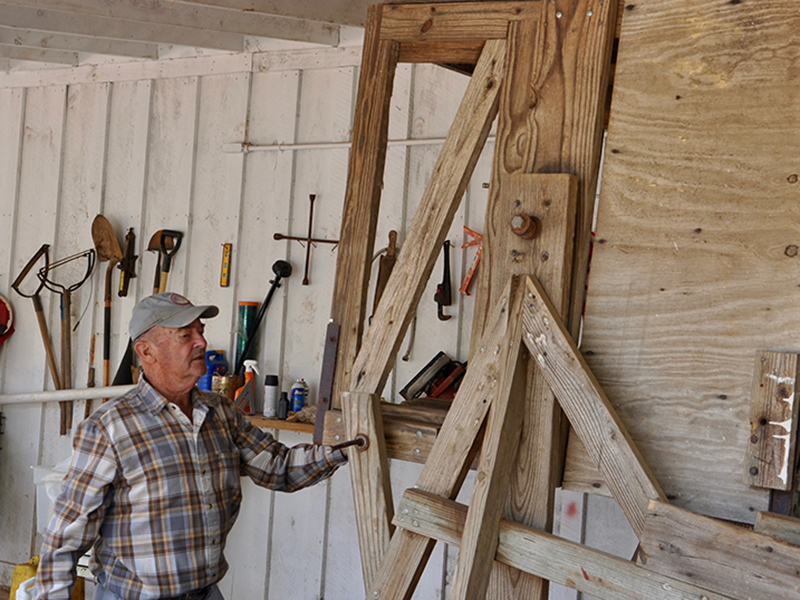
Every apple on the orchard is grated by hand. They are picked one-by-one, put into 20 bushel bins and put in a grater that was constructed in the 1800s.
A thousand pounds of apples are placed in the grater and let down by hand. Given the way it was built, the task can be completed with one, single hand, Joe said.
“It’s an old system, but it works good for me,” he said. “That thing is amazin’.” Toward the end of July, early August, the Dickey’s will have some delicious apples, produce and pastries ready, Joe said.