
Editor’s note: This is the third in a series of stories that were written by students in Jodi Williams’ English 1101 class at the University of North Georgia Blue Ridge campus. They are first-hand
accounts of local people who have made an impact on the authors. As you read them, you will see ordinary people doing extraordinary things.
---
By Sydney Petty
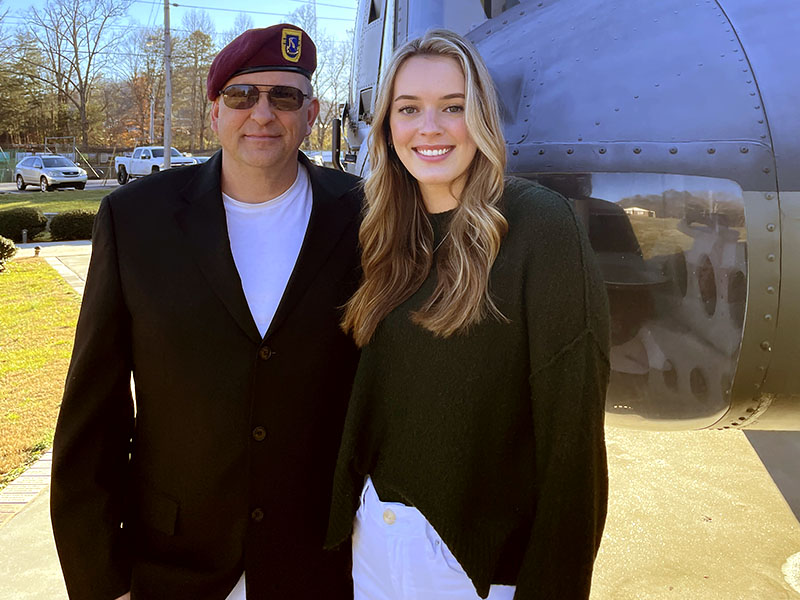
They say the 82nd Airborne is the most feared division in the world. The all American division devils in baggy pants. “We were considered an elite division because of our capabilities of going in by land, air and sea. We could be anywhere in the world in 18 hours. We were a force to be reckoned with.” Denton Petty is a retired combat veteran who served in Desert Storm in 1991. Denton was assigned to the 82nd Airborne parachute infantry regiment and was HHC 2504 but was attached to Charlie Company. He was born and raised in Blue Ridge, Georgia and is the son of Doyal and Glenda Petty. Denton went into the military in September of 1990.
“After I graduated I spent two years blundering around trying to find something that was meaningful, something that was going to amount to something.” He had been working with the local fire department until he decided one day he wanted to be a medic for the United States military. When he joined, they sent him to basic training in Fort Bliss, Texas. After he graduated from basic training, he was sent to San Antonio where he completed his advanced individual training and received his medical training.
“In the middle of the night they came and woke us up and said everyone who was going to airborne school had to be downstairs and on the bus.” Denton rode this bus from San Antonio all the way to Fort Benning, Georgia. Fort Benning is where he attended jump school and became a paratropper.
“After I’d had about 30 jumps I looked at my squad leader while we were about to jump and I said, ‘Does this still scare you?’ He said, ‘Yes, and if it don’t scare you we’ll find you something else to do. Fear keeps you safe.’”
In 1991, Operation Desert Storm began when the United States responded to Saddam Hussein’s invasion of Kuwait. “We were fighting for their freedom, the ones that were being killed, and fighting for each other. When you go to war there’s always more than one driving force.” The Disaster Response Force was the first unit to respond, within 18 hours of getting the call they were on the ground in Iraq.
“Nobody believes that you’re going to end up in war. My drill sergeants told us ‘you will see war in your enlistment,’ and I didn’t believe them.” Denton was at Fort Bragg when he got the call he was being deployed.
At the time, Denton and his platoon did not believe them because they were so used to getting calls that were simply just drills.
“They started giving us live ammunition. That’s when we knew that it was real.” Denton and his platoon landed in Saudi Arabia and were filled with a mix of excitement and fear.
“This is what we trained for. We were warriors and we were ready to go to war.” Denton describes the hardest part of being at war was missing home, which is being in the United States and being free. He told stories about being in a foreign country with people trying to kill you as not only a physical challenge, but an incredibly difficult psychological experience. Denton was the platoon medic and was responsible for 30 men. He was their first line of treatment. He describes the scariest time in Iraq as a time when he became lost. He was traveling through Iraq with his platoon trying to get to the Euphrates. They were driving day and night, but every now and then they were allowed to stop. There was an ambulance that followed the men and in the ambulance there was electricity. At night there was light discipline. You could have no lights on for the enemy to see. However, some nights the men could seal the ambulance up and play cards inside. At this time, they were burning oil wells in Kuwait. You could not see anything in front of you, it was so dark. Denton was trying to make his way back to the truck from a long night of playing cards in the ambulance. He went to the left too far and became lost.
“These Iraqis would come and try to get close to us. I knew they were out there.” Denton knew if he kept walking he could possibly run into the enemy. He laid down, covered himself in sand and waited until day break. The United States military captured thousands of Iraqi soldiers in Operation Desert Storm. The United States had cut off all forms of communication for the Iraqi soldiers. Denton says when they found the soldiers, they had no idea what was going on; they were starving to death with no supplies.
“We would capture them and take them back. I felt so bad for them. Sometimes I’d give them food.” Denton says some of the men in his platoon were not nearly as forgiving. Denton describes the prisoners of war as humans who were ordered to do things just as he was. He describes a personal experience he encountered with one Iraqi prisoner of war; “I had given him something to eat, and he told me he was sorry. He showed me his scars and told me he didn’t want to fight anymore.” After the war was over, trying to get the soldiers home drug out for quite some time. To Denton, the process felt like an eternity. Rumors about going home spread throughout the troops for weeks at a time. None of them seeming to be true.
“They told us we were going home. Nobody believed it. We got our stuff ready and got on planes and when it lifted off, everyone was yelling and screaming. We knew we were going home. That was the best time.” Denton had been in Iraq for 10.5 months. When the American soldiers landed in Fort Bragg, they went back to the barracks and turned in their weapons.
“I got in my truck and I drove to Blue Ridge.” Denton came home on a two week leave where he was able to see his family and friends. He describes his experience at home as being incredibly welcoming. Denton arrived back at Fort Bragg and was from there deployed to Panama in Central America. This is where he completed jungle operations training. “We learned how to survive in the jungle, we learned how to go to war in the jungle.”
After three months of being in Panama, Denton came back to Fort Bragg where he completed the rest of his service. His last jump was at Fort Bragg where he, unfortunately, encountered a foot injury. Denton broke his foot in three places and was able to go home to family. Denton completed his service in 1993. “What I learned was to appreciate all that I have, I appreciate this country and our freedom.” Denton is most proud of his ability to never give up or turn down an obstacle put in front of him.