
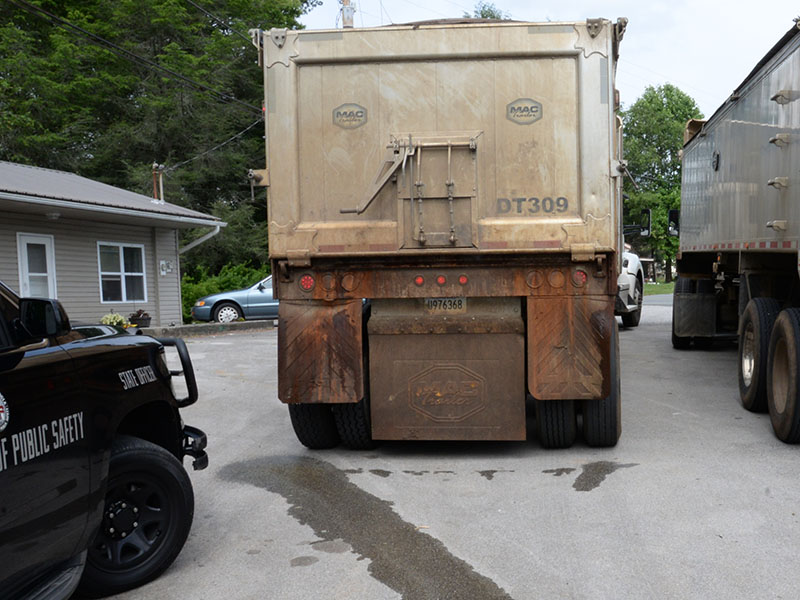
The smell was not the reason for stopping an Atomic Transport truck, but once the sickening odor was detected a new level of concern arose.
Concern began with the McCaysville Police Department, then reached the state Motor Carrier Compliance Division (MCCD) and then Georgia’s Environmental Protection Division.
As a result, Atomic Transport was told to stop hauling its cargo on Georgia roads, but whether or not the carrier complied was in doubt late last Friday afternoon.
The chain of events began Monday, May 22, when McCaysville Police Chief Michael Earley saw a large, 18-wheel dump truck turn from Blue Ridge Drive onto West Tennessee Avenue.
Concerned about the truck being overweight for the Fightingtown Creek bridge, Earley and Sergeant Brian Collis performed a traffic stop on the truck. A second Atomic Transport truck would be stopped soon afterward.
Earley said both drivers admitted knowing they were doing wrong by traveling the backroad route.
They said they had been told to take the route by their boss, Mitch Bradley. That order resulted from a person they knew as Buddy Haynes’s wife not wanting them to come through downtown Copperhill.
Sarah Mickens confirmed Monday she had told the trucking company not to come through downtown McCaysville/Copperhill because of the odor and the negative impact it could have on tourism. She said she did not specify a route they should travel. She said she voice her concerns specifically because of the large crowds when the train is in town.
The trucks were traveling West Tennessee Avenue, continuing on Mobile Road, then back through Grassy Creek and Highway 68 to reach their destination at Copperhill Industries.
The drivers both said there have been four trucks each making two trips a day for six to eight weeks. They said they were hauling “human s...”
The conversations between Earley and the drivers were recorded on body cams.
Copperhill Industries owner Buddy Haynes said he did not know what the trucks were hauling, only that they were not hauling Class A biosolids. He said it is not the
“exceptional quality” grade of Class A biosolids that he is using as his part of a pilot program at Copperhill Industries.
Kim Schofinski, deputy communications director for TDEC wrote in an email, “We would not characterize what is being transported as “raw human waste.” The material is solids leftover from the wastewater treatment process, which are then treated physically and chemically to produce a semisolid, nutrient-rich product known as biosolids. This product is then used as fertilizer or soil amendment.”
Earley said while talking to the drivers his throat became sore, his eyes began to water and he got a terrible headache.
Earley sought assistance from the MCCD.
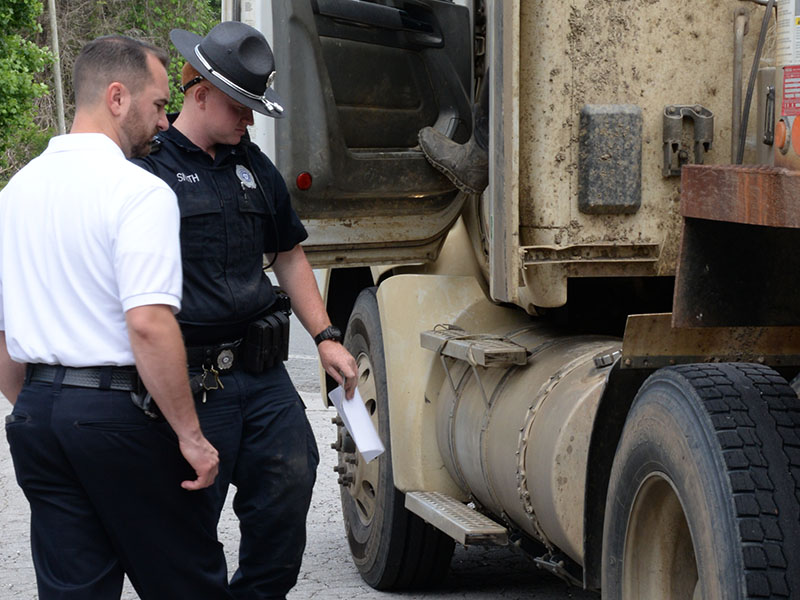
The next day, Tuesday, May 23, Officer Hayden Smith, along with Earley ad Collis, stopped three Atomic Transport trucks traveling on West Tennessee Avenue.
Smith’s examination report of each vehicle shows it is coming from Kennesaw, Georgia, headed to Copperhill. The shipper is Deanli Water Solutions.
The bill of lading cargo listed is Garbage, Refuse, Trash, the state information determined for Commodity Description is “human waste/sludge.”
The estimated weight of the load the trucks are carrying is 40,000 pounds or 20 tons.
Smith discovered nine violations, and issued one citation and one warning among the three trucks he checked.
Smith could not write citations for being over the Fightingtown Creek Bridge weight limit because there is no weight limit sign on the bridge.
Both Earley and Assistant Chief Cory Collogan confirmed the sign was in place approximately four months ago when all new signage was placed on the bridge.
Working with Fannin County Commission Chairman Jamie Hensley, a new weight limit sign was in place by the next day around lunchtime.
Earley contacted the EPD and the next afternoon, Wednesday, May 24, is told by EPD officials Matthew Stickney and Russell Nix that Atomic Transport does not have a permit to transport biosolids/sludge in Georgia.
EPD was to send Atomic Transport a letter of non-compliance the net day.
In the meantime, Earley called Mitch Bradley, who the truck drivers identified as their boss, to tell him of the situation and advised him violations were punishable by a fine of up to $25,000 per day per truck.
Earley also explained that once the proper permit is obtained, the trucks would have to stay on the main streets, Blue Ridge Drive and Ocoee Street, and travel straight through the middle of town when coming through McCaysville.
No Atomic Transport trucks were seen traveling through McCaysville Thursday, May 25.
However, an unconfirmed report of one being spotted on Mobile Road was received Friday afternoon.