
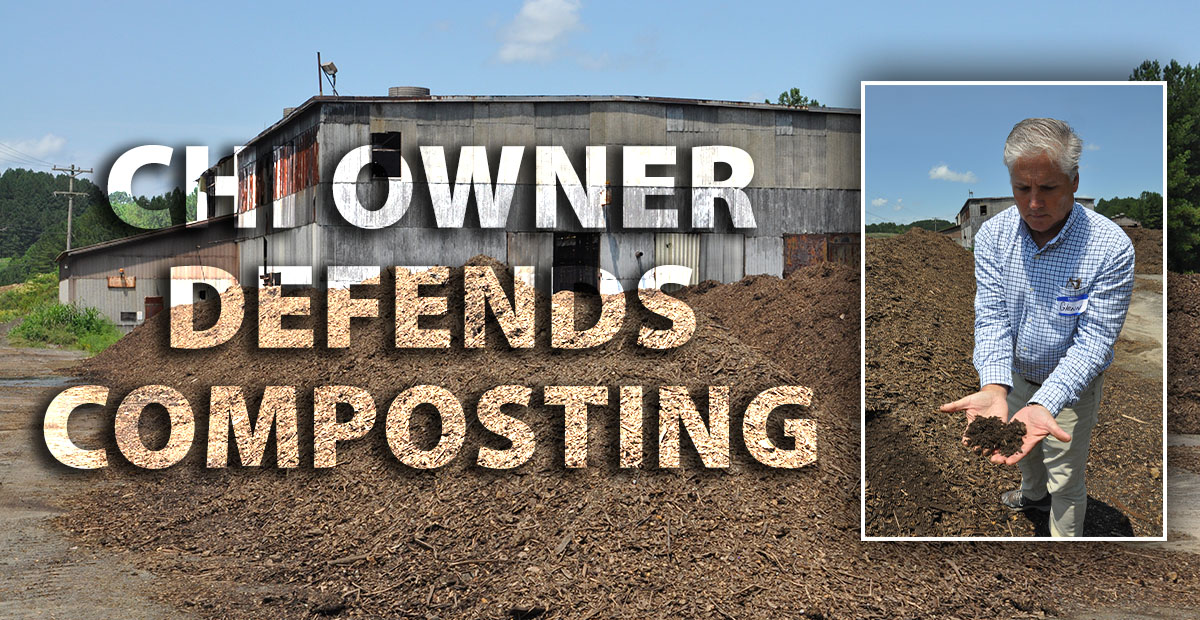
Copperhill Industries LLC (CHI) invited current elected officials, incoming commissioners and community leaders for a tour of the CHI site last Tuesday, August 2.
Before the tour started, CHI owner Buddy Haynes set out to put the people of Copperhills’ minds at ease about the controversy that the company has found itself in.
Haynes started by stating, “I know that there has been a lot of misinformation out on social media, and I want to try and correct that.”
Whenever CHI initially set out to increase the vegetative state of the site, which Haynes said was a task set by the Environmental Protection Agency (EPA) and state, they immediately ran into problems. The soil at the site was a very “acidic environment” with a pH of around 2.0, meaning “it won’t grow anything,” said Haynes.
Haynes said prior to failure, they originnaly tried to use techniques that are standard in the industry.
The EPA ultimately made the recommendation to implement biosolids to make the failures successful. The Tennessee Department of Environment and Conservation (TDEC) then got in touch with the Moccasin Bend Wastewater Treatment Facility to get the approved permit that would allow the biosolids from the treatment facility to be transferred to CHI.
Polk County commissioner-elect Mush Davis asked, “Do you have a lot of water run-off from this compost you’re spreading?”
Haynes had earlier said that water contamination would not be an issue.
He stated, “Most all of the water that’s generated through storm water and generated here goes through the Cantrell Flats Water Treatment Plant...there’s probably two or three million gallons a day that’s treated and released to the river.”
Haynes also said that next to where the composting operation is located, there is the Davis Mill channel, which is not a creek. “It’s a treatment system. All that water goes down across (Highway) 68 and is pumped back to the treatment plant and is treated.”
Davis responded, “That’s what concerns a lot of people, is water contamination...that’s a problem, and odor is a problem.”
The odor being so close to where people are residing and doing business is as a major local concern. The facility itself is roughly 1,900 acres, making it approximately two miles wide and three miles long. Haynes assured tour attendees that the biosolid site itself would be at least a mile from Highway 68, Highway 64 and downtown Copperhill.
When asked what the actual cause of the odor was from, CHI employee Sarah Mickens stated, “Any time there is a lot of rain...you’re definitely gonna have a little bit more odor...it does have to stay to a certain dryness...it’s a process.”
Haynes continued, “Ideally, we would have it under a roof, so you can control the moisture, and that’ll probably help with odors too, and that may be a possibility in the future, but we can’t control the moisture now.”
Haynes read a statement from the EPA stating, “The presence of biosolid odor does not mean that biosolids pose harm to human health and the environment.”
Glenn Dowling, with Denali Water Solutions, stated, “Odor is always the issue, but it’s part of the natural cycle.”
CHI will be hosting a community Open House event Saturday, August 13, from 10 a.m. until 2 p.m. which will include displays.