
Editor’s note: This is the first in a series of stories that were written by students in Jodi Williams’ English 1101 class at the University of North Georgia Blue Ridge campus. They are first-hand accounts of local people who have made an impact on the authors. As you read them, you will see ordinary people doing extraordinary things.
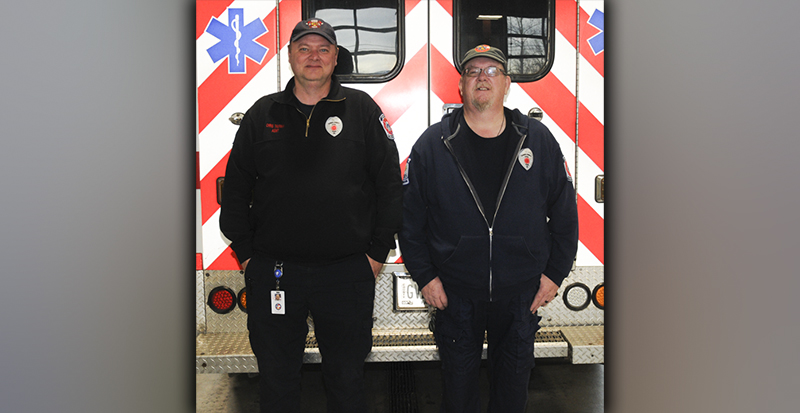
The radio in the ambulance blared the piercing tone, interrupting the chatter that was already going on from a fire alarm call, alerting us another call was coming. We were in Blue Ridge in Med 11, one of Fannin County’s four 24/7 manned ambulances (but today, due to personnel shortages, we’re down to three) headed to help on the fire alarm call. This call was for Med 4 (the McCaysville based ambulance) for a 71-year-old male with a leg injury due to an accident with a chainsaw. Just seconds from being on scene, Bobby Long, the paramedic on the truck, said, “Hold on, let’s pick that up, we’re closer.” After getting clearance from command on the fire scene, we diverted. I flipped on lights and siren as we made our way through the busy downtown traffic.
“If there’s possible nerve damage or mobility issues, we’re flying them,” Bobby said.
We arrive on scene and find the patient sitting in a dining room chair, a belt acting as a makeshift tourniquet around his leg, holding pressure with 4x4 dressings (at least this guy knew to do that).
“Let’s see what we’re looking at,” Bobby said.
The patient removed the dressing temporarily, and bright red blood shot out rhythmically with every heartbeat: an arterial bleed, but not as bad as it could have been.
“What do you need?” I asked Bobby.
“Just a little Coban, and we’re good to go,” he said, calmly.
A few short minutes later, patient loaded, vitals taken, I.V. established, and we’re en route to the hospital. This patient is going to be fine (not all are so lucky).
With 37 years on the job, there isn’t much Bobby Long hasn’t seen. He came to work at Fannin County Fire Department in 1984, at the age of 17, earning his cardiac tech (CT) in 1986 and his paramedic license in 1992.
No matter the call, Bobby’s demeanor is always the same – whether the patient is a 90 year old woman who can’t get off the floor, or a 50 year old man in full cardiac arrest, or a motor vehicle accident with entrapment or severe injuries it doesn’t matter – you do your job, do it calmly, politely, and you do it with absolute professionalism.
Bobby still remembers his first call, a 20-something-year-old male who had wrecked a Jeep on Highway 5, just outside of Blue Ridge. He recalled that it was before safety glass was installed in windshields, and this guy had went headfirst through the windshield.
“It looked like someone had scalped him,” Bobby said. “So here we are trying to stop bleeding, and this other guy comes up with something that looks like a dead, bloody rat, and it was this guy’s scalp.”
He told of how they got this guy to the hospital and they stayed with him in the ER for three hours while they reattached the scalp.
Bobby was born in Germany, due to his father being in the U.S. Army, and credits his Uncle Kevin Davenport, along with the show “Emergency” for getting him interested in the career field.
EMS can be an emotionally taxing way of life, to say the least. The years of working 24 hour shifts, waking at all hours of the night, your emotions can go from “zero to 60” in a matter of seconds, waking up to a call for a full cardiac arrest, or an MVC with entrapment, only to arrive on scene to thankfully find everyone okay or worse when you get paged out on a call that sounds basic, and arrive to find someone in the last minutes of their lives, it takes its toll. When asked what has kept him in it, he simply answered, “Every time that I think I’m ready to quit, we haul that one patient that actually needs help, and I can do something for...You can’t walk out on that.”
Bobby indeed shows a true compassion that seems to stand out in a career field known for those that do just that. Even at three in the morning, after being up 20 plus hours (most Fannin firefighters and EMS work a “24 on, 48 off” schedule) when he has to deal with something as simple as an elderly patient worried because his blood pressure is high.
That compassion extends to his personal life as well. Bobby and his wife, Kimberly, are foster parents that have adopted five children from the foster system (along with two biological children of his own). His strong work ethic, even when he had to work two full-time EMS jobs (96 hours a week) for 19 years has allowed his wife to be a stay-at-home parent, to give their family the care it deserves. Bobby now works what is known as a Kelly shift, which is a 24 hour shift on Wednesday and another on Saturday, which allows him to help home school their children.
Being in a career field so long, to say you see many changes is an understatement. When asked about those changes, Bobby said the single largest change has been the dependence on technology.
“You did your entire patient assessment based on your two eyes, your stethoscope and your hands. If there is a problem with the technology, the newer medic is lost. Newer medics are taught to depend on technology. This isn’t a factor, you can’t shut down production for a few hours until we get this fixed. Patients aren’t ‘production.’ You’ve got to be able to look at a patient and say, ‘I don’t care what the pulse ox says. This patient is hypoxic.’”
On another call where the patient had high blood pressure, he called for fluids. The purpose of giving of fluids is usually to raise blood pressure, but he explained, “I know they taught you that fluids raise blood pressure, but watch this, in this case it will lower them. This lady is dehydrated.”
He administered the fluids and her blood pressure came down. By the time the patient had arrived to the ER, she had improved to the point to where she seemed like a different person. When asked what led him to make that decision, he explained how she said reported having a UTI and a fever, and he noticed her tongue was white and scaly. That kind of knowledge comes only with the kind of experience gained from years on the job combined with a dedication to research, and always trying to understand why something, not just treating it.
That research is another thing that sets Bobby Long apart from many others. Many days he comes into work explaining an article he read about changes in recommended treatment, new information on medications, or the way another department is handling a problem. Staying up to date in the most current practices is just another way Bobby ensures that his patients receive the best possible care he can give them.
Sadly, the number of paramedics like Bobby are falling. The low pay (after two years of school and over 37 years on the job, Bobby makes less money than most RN’s fresh out of school) and working conditions have taken their toll on the career field as far as attracting new personnel, while injuries like back injuries from moving patients, stress and “burnout” keep most from making it on the job long enough to develop the kind of knowledge and experience the older medics have. Unfortunately, the answers (on a national level) isn’t to work to better the pay and conditions to combat low recruitment numbers and employee retention, but to lower the requirements to work on an ambulance.
This is where the discussion was going when the tones dropped again: possible copperhead bite on Rock Creek Road. Fannin County Firefighter/Paramedic 202, Bobby Long, gets up from his seat and heads to Med 11, off to do what he does best. The patient will have no idea of his stories or experiences, the things he has seen, the dedication put into the career field, but they will no doubt be thankful someone like Bobby Long is there to answer the call.