

The request by Johnnie Hastings to rezone a 14.15-acre parcel along Appalachian Highway (515) was tabled following nearly two hours of discussion Tuesday, January 12.
On behalf of Integrity Development Group, LLC., Hastings presented their intentions with the property.
Although this is the first time before the council, the Planning Commission voted in approval, with Commissioner Angie Arp in opposition, December 1.
Additionally, this is Hastings’ second application as he went back to the drawing board following negative community feedback.
However, in presenting his case, despite applying for zoning from General Commercial to High-Density Residential to incorporate an 83-unit townhome community, Hastings proposed the same zoning, but for 56 single-family units, at 4 units per acre.
He coined it “Social at Blue Ridge.”
He explained the change was made to accommodate the citizens’ concerns following the feedback he’d received.
“Nobody’s trying to pull a fast one here,” Hastings said. “My goal as a developer ... is to be invited back. I’m gonna own one of these homes. I’m gonna come downtown and eat. I don’t want people looking at me like, ‘You know, gee, Johnny. You really screwed this deal up.’”
He also referenced a community open table that was held at Comfort Inn of Blue Ridge to allow him to hear and address concerns; however, that was later deemed to have solely included Overlook Blue Ridge residents.
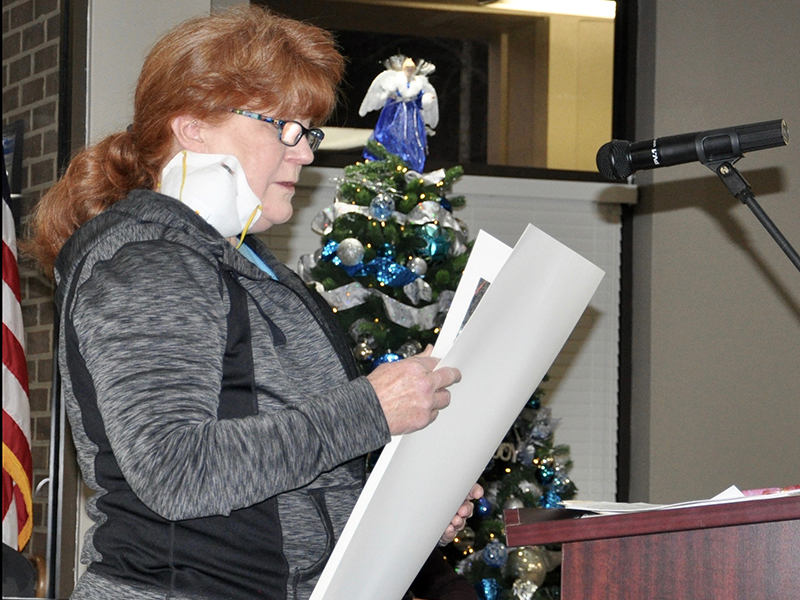
“This is a new plan, and with all due respect to you, Mr. Hastings, this has not gone before your Planning Commission, so the recommendation that the Planning Commission put forward was for something entirely different,” Donna Thompson, a resident just outside city limits, said after hearing the plan.
“This is all new to us. I’m taking notes. ... He says that he’s spoken with us. Nobody from their group has spoke to me in months. ... This is the first time that we’ve even heard that they were reducing the amount of, you know, homes in there, and the fact, it concerns me that you would vote on this when the Planning Commission has not.”
With that said, Hastings then reiterated that he is reducing the density, but requesting the same zoning change that he’d applied for.
After a text was sent to City Attorney James Balli by Mayor Donna Whitener and Councilwoman Rhonda Haight, it was informed that as long as the density was being reduced, and not increased, the council may vote on it.
The opposing party was granted five minutes each to present their case after a council vote, and after hearing from many concerned citizens, the council voted to table the decision until next meeting in order to have Hastings present an updated site plan, which will be available on the city’s website, www.cityofblueridgega.gov/.
Councilman Nathan Fitts recused himself from the vote as his father’s property is located next to the proposed development.
Councilwoman Rhonda Haight voted no as she felt “we’ve kept people waiting long enough.”
Citizen concerns included the use and access of College Street from the development, failing infrastructure, lack of the council representing the people’s voice, a lack of following procedure, and the fact that the plan had been changed without informing the public of the changes prior to the hearing.
Thompson addressed Hastings’ claim of having obtained approval from the Georgia Department of Transportation (GDOT) for curb cuts on the highway.
After reaching out to GDOT, an engineer informed that nothing had been received regarding the project, she said.
She explained that this concerned her as they may not be able to incorporate the highway entrance.
James Fitts, who said he lives 30 feet from the proposed development, said he would prefer homes be built as to commercial property.
Utilities Director Becky Harkins insisted that the sewer plant is only at 40% capacity and that the water treatment plant also has capacity available for the development.
She explained that there are upgrades in the process at the sewer facility, and they will take place regardless of the development.
Agreeing that the city does see water loss, Harkins said, “The city is working on those water loss issues. If you talk to other cities in mountainous areas, you will find that they have similar situations. Aging infrastructure is a growing problem among the water and sewer industry, and I agree that it needs to be worked on. It needs to be worked on diligently, but the fact remains that we cannot deny water and sewer service to somebody when we, in fact, do have the capacity to serve those.”
She noted that around 10% of water loss comes from communities outside of city limits that were taken over, and nearly a million dollars was spent recently on upgrades to the lines downtown.
The developer would be responsible for tapping on and any necessary upgrades to the system, she added.