
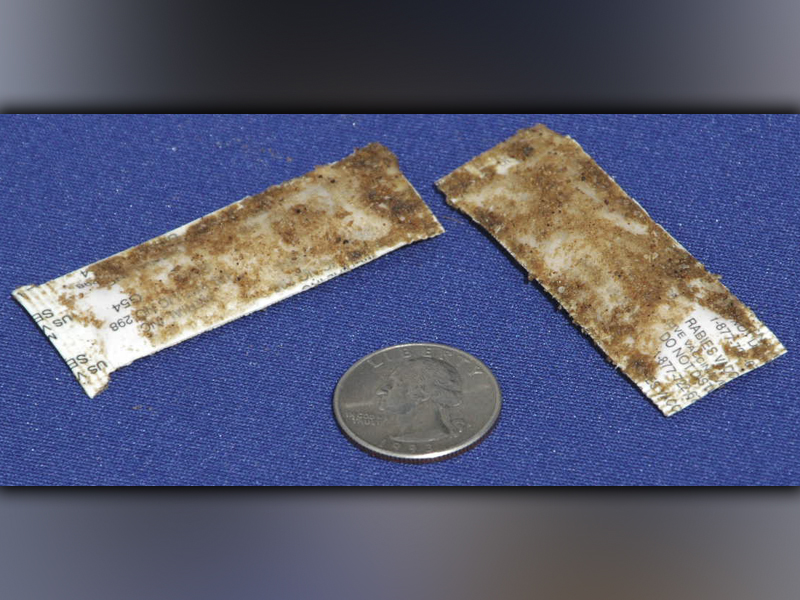
Small, ketchup-sized packets found outdoors by several Fannin County residents caused enough concern that a representative of the United States Department of Agriculture (USDA) attended the Tuesday, November 9, board of commissioners meeting to relieve any fear.
Commission Chairman Jamie Hensley said he wanted residents to know the packets, part of a USDA program to stop rabies, pose no fear to humans or domestic animals. The USDA representative agreed to come to the commission meeting after the source of the packets was discovered, Hensley said.
Daymond Hughes, a wildlife biologist with the USDA’s Animal and Plant Health Inspection Service, said the packets contain an oral vaccine that has been tested on some 60 species of animals and found to be safe. There have been no ill effects from humans coming in contact with the packets.
Hughes said if anyone finds a packet, and wanted to get rid of it, they could pick it up with something as simple as a tissue and throw it into the woods or the garbage.
Hughes, who spoke at the November 9 meeting, said the packets were part of a bait drop conducted in Fannin County that ended in October. That drop was part of a USDA program to fight rabies in raccoons all along the eastern part of the United States.
Hughes said raccoons and skunks are the primary target of the program because rabies in them creates expenses of about $500 million a year in the eastern U.S. alone.
The program began in 2004 and in recent years the drops have been made in several northwest Georgia counties including Walker, Dade, Catoosa and Whitfield. Because of the program’s success there and in other areas, it is moving eastward and now includes Fannin County.
The bait drop will occur in Fannin County every year, Hughes said.
The next step will be for USDA employees to trap raccoons and skunks in the baited areas beginning the week after Thanksgiving.
Fannin County has given the USDA permission to use county road and highway rights-of-way so that private landowners won’t be bothered by the trapping.
The raccoons will be tested, tagged and released back into the areas where they are trapped, Hughes said.