
History honored
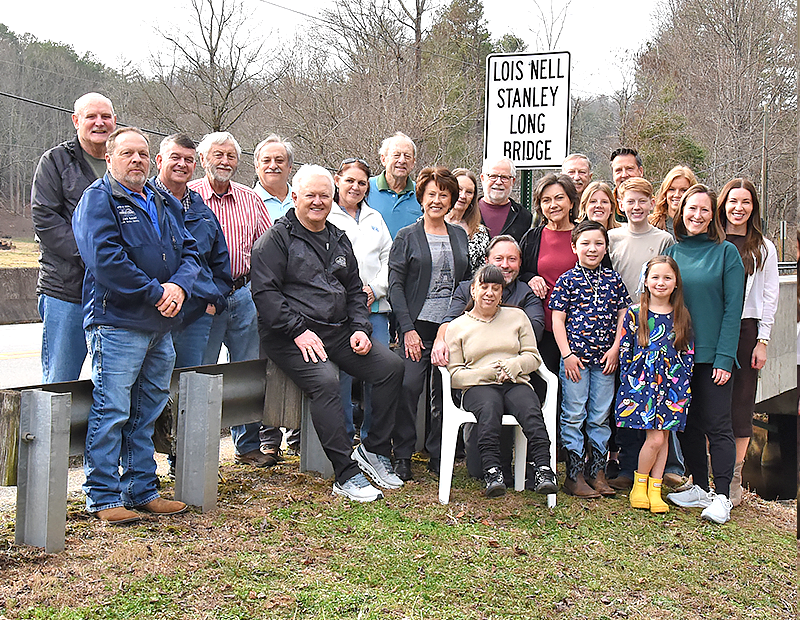

A large part of rural Fannin County history was honored Thursday, January 8, when the bridge over Big Creek on Aska Road was dedicated as the Lois Nell Stanley Long Bridge.
The dedication memorialized two pioneer families in what is now the Dial area of the county, the Longs and Stanleys.
Fannin County Commission Chairman Jamie Hensley called the dedication, “A testament to your families and your mom. I appreciate you,” he said.
Post 1 Commissioner Johnny Scearce said by dedicating the bridge the people who created the history of Fannin County were being honored.
Post 2 Commissioner Glenn Paterson commented that, with so many family members present, “We’ve got our future right here.”
Freddy Long, thanking the commissioners, said of the dedication, “It stabilizes our mother’s name in history.”
Freddy, at 63 years old, is the youngest of the five children of Lois Nell and Herman Long. Merle, at 83 years young, is the oldest and in between are Gina Golden, Cathy Scruggs and Gerald Long.
After the dedication ceremony, which was right across Aska Road from the old Long family home place, Freddy traced the family history that dates back well over a century.
The house built by Henry Long that sits on the nearby hillside predates 1879 and was likely built in the early 1800s.
Freddy told how his father, Herman, would walk past that farm on his way to “court” Lois Nell Stanley, always dreaming he might one day own the farm. Herman’s family lived in the area behind where Fannin County Fire Station #3 is now located.
Herman’s father, Monroe Long, died at age 42 when Herman was only four years old. Herman went to work in the CC Camps when he was 16 years old to help his mother, Elizabeth Long, raise the family.
Returning home, there was no work so he went to Danville, Virginia to work in the spinning mill.
In 1942, he married Lois, and took her back to Virginia with him. He was 21 and she was 22.
This didn’t sit well with her father, Walter Stanley, who didn’t want his daughter to leave home.
Walter knew of Herman’s desire to own the Long farm, and it was about this time Henry Long passed away.
Walter was a sawmiller, known as a smart businessman. He knew there was enough good timber on the land to pay for the farm, so he made Herman a deal. He would go in halves on the farm with Herman if Herman would come back and help him saw the timber. Walter told Herman he would earn enough money to pay fo his half. Walter knew that half “would be enough to buy the whole place,” Freddy said.
Walter wanted to make sure his new son-in-law would stick with the deal.
Herman accepted the offer. This had an extra benefit besides bringing Walter’s daughter back home. Since the boards being cut were for military ships, Herman was told to stay at home. He was not drafted because his work was supporting the war effort, Freddy said. “It was a win-win for everybody,” Freddy said.
Sure enough, Herman lived up to his end of the bargain and worked off enough money to buy half the farm. In fact, enough money was made that Walter sold the entire farm to Herman.
From there the story of the five children present for the bridge dedication begins.
Herman and Lois raised, “God fearing Christian people,” Freddy says. They are all part of a community known for neighbors helping neighbors. It was as if everyone was one big family. “You call people your aunts and uncles even if they aren’t,” Freddy said.
Although all five had to leave the home they loved to find work, all five children now live within four miles of each other.
The home place, like the children, is not going anywhere. “We keep it as a whole. We all use it as we did,” Freddy said.