

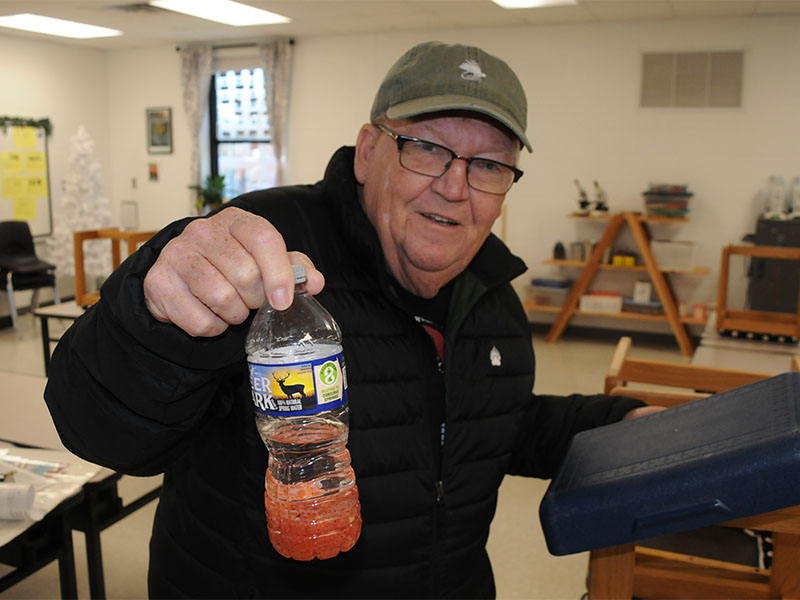
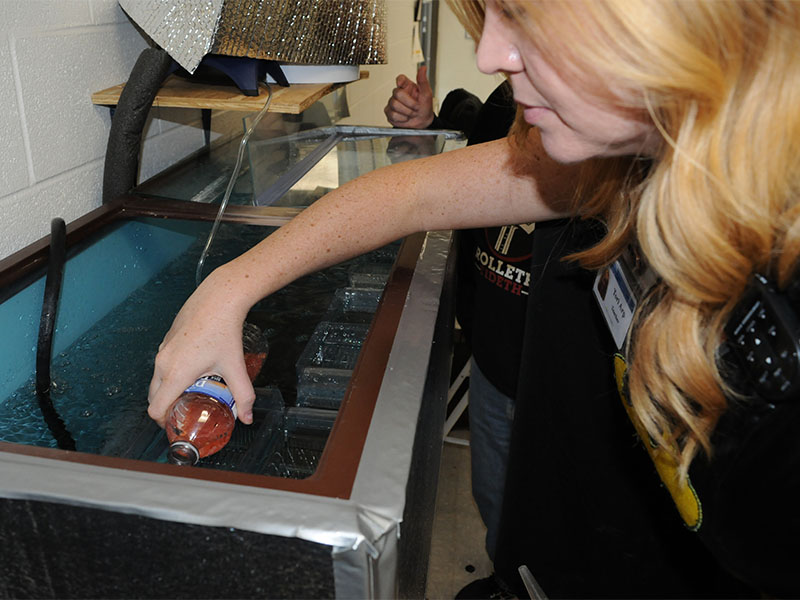
Blue Ridge Elementary School(BRES) STEM teacher Tori Arp received a shipment of roughly 200 rainbow trout eggs to raise with her students.
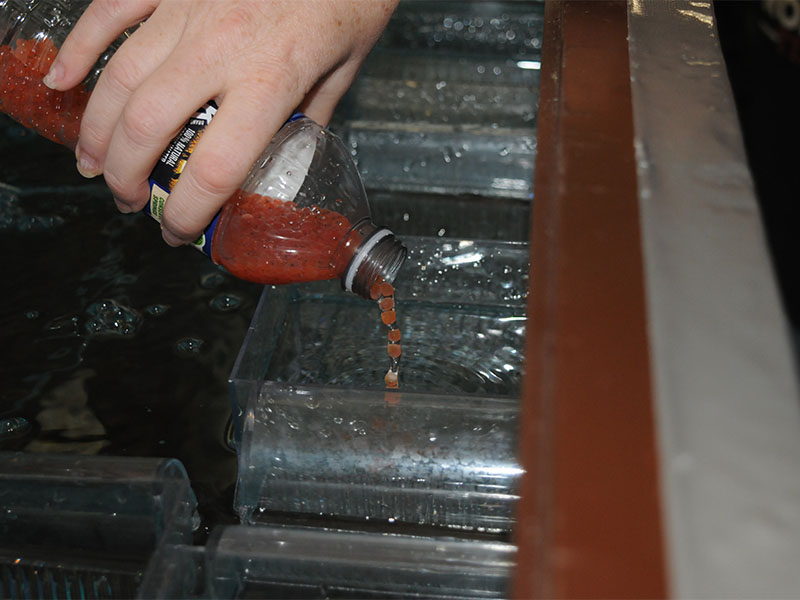
The eggs, which resemble red-tinted pearls, come from Trout Unlimited’s Trout in the Classroom Program.
Trout Unlimited is a trout conservation group with hundreds of local chapters across America.
Altogether, the eggs fill up just the bottom quarter of a plastic water bottle.
“We’re supposed to have brook trout in our streams,” Arp said. “That’s what’s native to the area.”
For Arp and the students entrusted with them, the eggs require a commitment to cleaning a fish tank, feeding the trout, and more until their release in May.
Although Arp is raising rainbow trout with her students now to release into Weaver Creek behind Fannin County Middle School, she hopes to one day raise native Southern Appalachian Brook Trout.
However, warm water temperatures in the creek mean these fish still lack a good habitat, she said.
“We are hoping with some eventual stream restoration projects that we can establish a sustainable population in Weaver Creek,” she said.
For the first few weeks, Arp will wrap the fish tank in panels to keep out ultraviolet light and pumps in highly-oxygenated water.
These conditions imitate a trout egg’s natural environment, hidden deep in a stream.
Arp uses well water from outside the school for the tank. Right now, BRES’s water comes out brown and isn’t drinkable, she said.
She will test the water daily.
Without this carefully-managed setup, many of the trout eggs would die, she said.
“About 90 percent of them will hatch,” Arp said.
But hatching is only the first challenge in a trout’s life.
While childhood for people is often a time of wonder and excitement, childhood for trout is violent carnage.
Even in safe conditions with plenty of food like Arp’s classroom fish tank, young trout will attack and eat each other.
It’s likely only half of the 200 trout eggs delivered will grow to become “fingerlings” or about two-inch-long trout.
In the wild, 90 percent of trout don’t make it from egg to adulthood, Arp said.
At the right stage, Arp and her class will release the trout into the wild so they can learn how to hunt.
“If you release them too early, they’re probably gonna get eaten at a higher rate,” she said.
But a trout released too late won’t learn how to hunt, she said.
“You can’t release a pet into the wild to go and prosper.”
For students, raising trout teaches them the cycle of life, the value of trout to Blue Ridge’s community, and many other lessons.
“We have kids that didn’t know that fish sticks were actually fish,” Arp said. “I’m talking middle schoolers.”
But those that do support a Blue Ridge trout fishing tourism industry worth more than $40 million, said Carl Riggs, the Georgia council chairman for Trout Unlimited.
“Once you get in the stream and you get your first trout, you’re hooked,” he said. “And I don’t even like to eat them.
Over time, trout fishing on the Chattahoochee has switched from being mainly about catching fish to eat to being mainly recreational, he said.
Classroom trout raising programs educate children more than they increase trout numbers, Riggs said. But they are still a valuable part of conservation efforts. Georgia’s four government fish hatcheries breed and release 4 million trout per year.
“That’s why it’s such a big industry,” Riggs said.
The brook trout native to Georgia have suffered some decline, Riggs said. The current breeding programs aim at releasing more native trout to mix with a replacement population of rainbow trout originally from British Columbia and brown trout native to Europe.
“We’ve lost so much habitat, and because of the predators and the rainbows and the browns, most of our brook trout locally are 2,000 feet or above in really small tributaries,” Riggs said.
Competition between these species and pressure from fishing has brought down the average size of Brook trout, Riggs said.
“The old-timers from back around when the settlers came in here in the 1830s said, ‘Oh yeah, we caught six-pound brook trout.’ I don’t believe that.”
Today, a 7-inch brook trout is a trophy fish, he said.